Udemy Course Filter Tool
Find Legitimate Free Udemy Courses
The tool helps you identify truly free courses (not previews) that meet quality standards. Use these filters based on the article's recommendations:
Results:
How to verify free courses:
- Check if it has full access (not just a preview)
- Look for 100+ reviews with 4.5+ rating
- Verify instructor has 10,000+ students
- These courses are usually introductory level
How to Use This Tool
After filtering, you'll see:
- Number of courses matching your criteria
- Key features of free vs paid courses
- Best practices for selecting quality courses
Remember: True free courses are rare on Udemy. They're usually introductory level courses (like "Introduction to Python" or "Basic Excel") from instructors building their audience.
Ever clicked on a Udemy course and seen "Enroll for free"? You’re not alone. Millions of people do it every month, hoping to learn new skills without spending a dime. But here’s the truth: Udemy courses are not free - not really. What you’re seeing is a marketing trick, not a gift. Most courses cost money. The "free" label usually means one of two things: either it’s a limited-time promotion, or it’s a free preview of a paid course. If you’re looking for real, full access to quality training without paying, Udemy isn’t your best bet - unless you know how to play the system.
What "Free" Actually Means on Udemy
When you see a Udemy course labeled "Free," it doesn’t mean you get the whole thing for nothing. Most of the time, it’s a preview. You’ll get access to the first lecture, maybe a syllabus, and a short video introduction. The rest? Locked behind a paywall. That’s how Udemy makes money. They let you sample the content so you feel confident buying the full course later.
But there are exceptions. Every now and then, Udemy runs a promotion where they make a full course free for 24 to 72 hours. These are usually old courses with low ratings or courses from instructors trying to boost their enrollment numbers. You might find a decent Python course or a basic Excel tutorial during one of these windows - but they’re rare, and they disappear fast. If you see a "free" course, check the date. If it’s been free for more than a week, it’s probably not actually free anymore.
How to Find the Real Free Courses
You can find real, full free courses on Udemy - but you have to hunt for them. Here’s how:
- Go to udemy.com and type "free" in the search bar.
- Filter by "Price: Free" on the left sidebar.
- Sort by "Highest Rated" - not by "Newest" or "Most Enrolled."
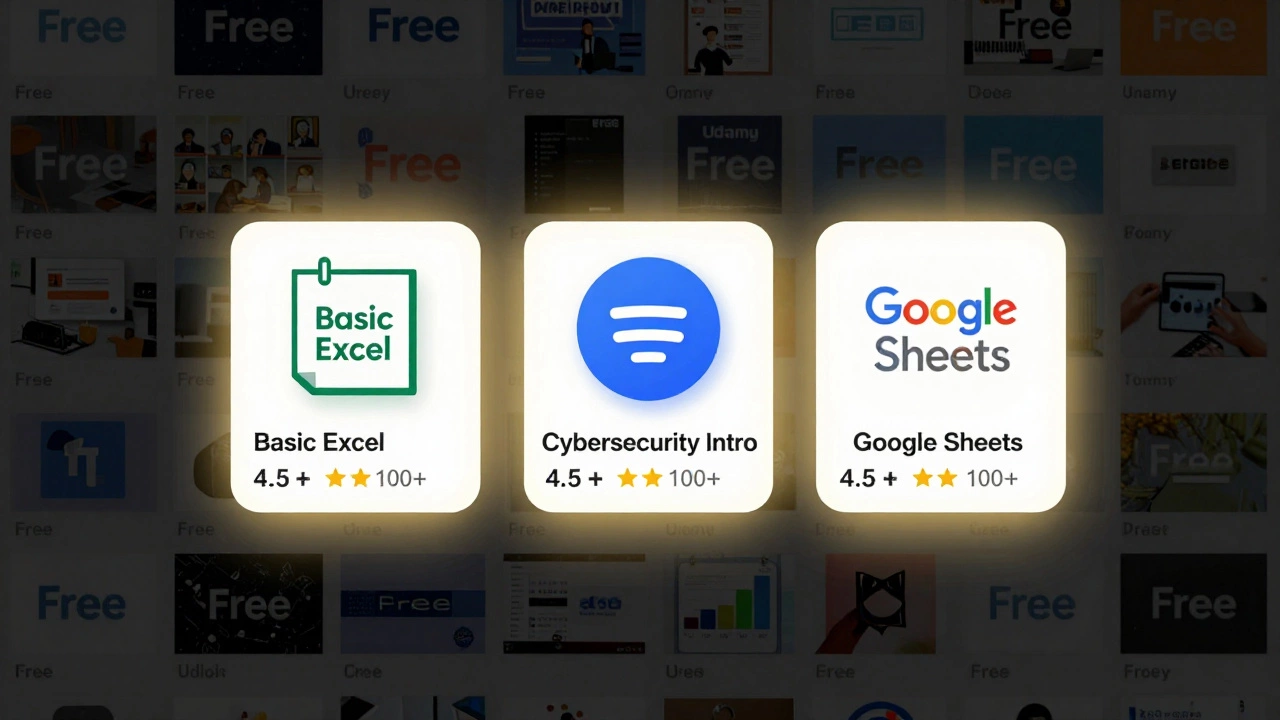
- Look for courses with at least 100 reviews and a rating of 4.5 or higher.
There are about 50 to 80 truly free courses on Udemy at any given time. Most of them are introductory: "Introduction to Google Sheets," "Basic English for Beginners," "Understanding Cybersecurity Threats." These aren’t advanced - but they’re legit. You’ll get certificates, full video lectures, and downloadable resources. No tricks.
Some instructors give away free courses as a way to build their audience. If they’re trying to get noticed, they’ll offer a full course for free. These are often the best finds. Look for instructors with 10,000+ students and a history of teaching. Their free courses are more likely to be well-made.
Why Udemy Doesn’t Offer More Free Content
Udemy is a marketplace, not a nonprofit. Instructors set their own prices, and Udemy takes a cut - sometimes up to 50%. If courses were free, instructors wouldn’t make money. And if instructors don’t earn, they won’t create new content. That’s why Udemy’s model relies on constant sales and discounts.
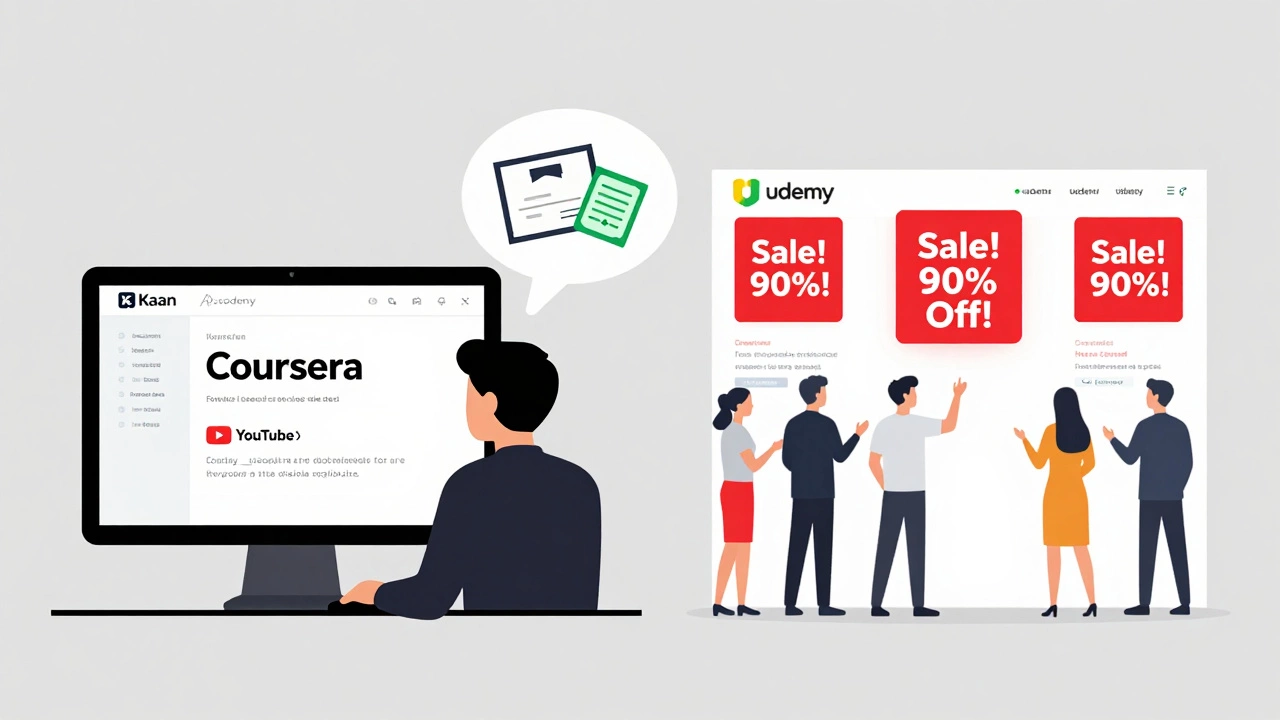
Compare that to platforms like Coursera or Khan Academy. Khan Academy is funded by donations and grants - so it can offer real, full courses for free. Coursera offers free access to course materials (not certificates) for many of its programs. Udemy? No funding. Just sales.
That’s why you’ll never see a free, full-length course on advanced topics like "Machine Learning with TensorFlow" or "Advanced Accounting Principles" on Udemy. Those require deep expertise - and instructors won’t give that away.
What You Can Get for Free (And What You Can’t)
Here’s a quick breakdown of what you actually get when you enroll in a free Udemy course:
| Feature | Free Course | Paid Course |
|---|---|---|
| Full video content | No (only previews) | Yes |
| Downloadable resources | Usually yes | Yes |
| Certificate of completion | Yes | Yes |
| Access to instructor Q&A | No | Yes |
| Lifetime access | Yes | Yes |
| Updates to course material | Yes | Yes |
Notice something? The certificate is free. That’s right. Even if you take a free course, you still get a downloadable certificate. That’s useful for your LinkedIn profile or a job application. But if you need help, feedback, or deeper content - you’ll need to pay.
Alternatives That Actually Offer Free Learning
If you’re serious about free skill training, Udemy isn’t the only option. Here are better places to look:
- Khan Academy - Free, nonprofit, full courses in math, science, economics, and computer programming. No ads, no paywalls.
- Coursera (Audit Mode) - Enroll in a course for free. You get all the videos and readings. Just no certificate or graded assignments.
- edX - Run by Harvard and MIT. Free access to course materials. Pay only if you want a verified certificate.
- YouTube - Search for "Python tutorial for beginners" or "Excel pivot tables full course." You’ll find channels like freeCodeCamp, Corey Schafer, and LearnVern with hours of free, high-quality content.
- Google Digital Garage - Free certification in digital marketing, SEO, and data analytics. No cost. No catch.
These platforms don’t trick you. They’re built to teach, not to sell. If you’re learning for growth, not just a certificate, they’re better choices.
When Paying for Udemy Makes Sense
Let’s be honest - sometimes, paying for a Udemy course is the smartest move. The platform runs sales almost every week. During Black Friday, Cyber Monday, or New Year, courses drop to $10-$15. That’s less than the price of a coffee. For that, you get:
- Full access to a course created by an industry professional
- Downloadable files, quizzes, and projects
- Access to the instructor for questions
- A certificate you can add to your resume
- Lifetime updates - so the content stays current
Many people buy one course at $12, learn a new skill, and land a better job. That’s a 100x return. If you’re serious about learning, paying $15 for a course on web development, project management, or data analysis is a no-brainer.
Just don’t buy on impulse. Read reviews. Check the instructor’s background. Look for courses with over 1,000 students and a 4.5+ rating. Avoid courses with 20 reviews and a 4.8 rating - those are often fake.
Final Verdict: Are Udemy Courses Free?
No. Udemy courses are not free. But you can get real value for free - if you know where to look. The free courses on Udemy are decent for beginners, especially if you’re just testing the waters. But if you want depth, support, or advanced skills, you’ll need to pay. And that’s okay. Learning costs money - but you don’t have to pay full price.
Wait for sales. Use filters. Compare alternatives. And never assume "free" means "full access." Udemy isn’t trying to trick you - it’s just a business. Your job is to be smart about it.