BA English Duration & Pathway Planner
Select your university's policy and your intended study plan to see the exact duration, degree title, and available exit credentials.
1. University Policy
2. Your Study Plan
Your Academic Outcome
Degree Title
--
Duration
--
Exit Credential Received
--Research Component
--Why this matters:
Select options above to see detailed implications for your career and higher studies.
Quick Reference: NEP 2020 Exit Options
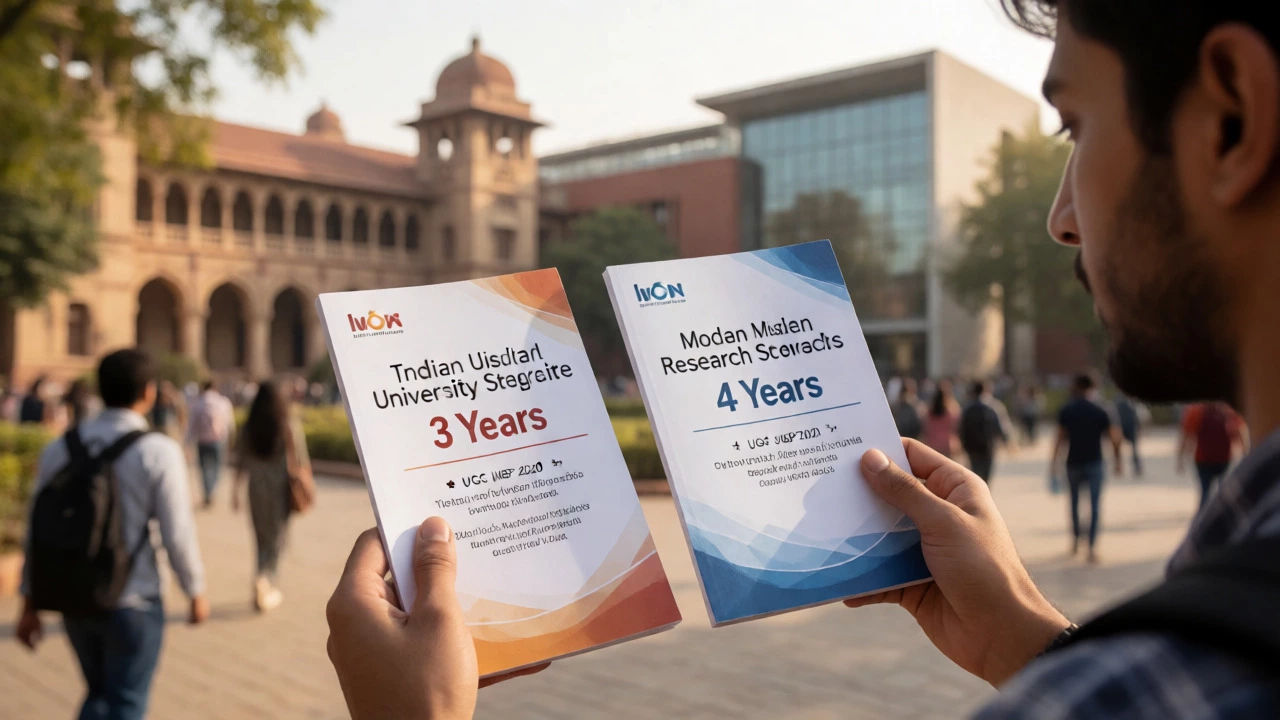
You’ve probably heard conflicting answers about how long it takes to finish a BA English undergraduate degree in India. Some say three years. Others insist on four. If you’re staring at admission forms or comparing colleges, this discrepancy can feel like a trap. Here is the straight answer: it depends entirely on which education policy your university follows right now.
As of 2026, the landscape has shifted significantly due to the implementation of the National Education Policy (NEP) 2020. Most major universities have transitioned from the traditional model to a new framework that changes not just the timeline, but the very structure of what you study. Let’s break down exactly what you are signing up for, so you don’t get blindsided by an extra year of college.
The Short Answer: Three Years or Four?
For decades, the standard BA English program in India was strictly a three-year full-time course. You joined after Grade 12, studied literature and language for six semesters, and graduated with a Bachelor of Arts degree. This was the norm under the University Grants Commission (UGC) guidelines that had been in place since the 1980s.
However, things changed when the government introduced the NEP 2020. The goal was to align Indian higher education with global standards, specifically the US and UK models where bachelor’s degrees often include more interdisciplinary depth. Under this new policy, many institutions are moving toward a four-year undergraduate structure. But here is the catch: it is not mandatory for every student yet. It depends on whether your specific university has fully implemented the NEP reforms and which entry year you belong to.
| Feature | Traditional Model (Pre-NEP) | NEP Model (Post-2020) |
|---|---|---|
| Duration | 3 Years (6 Semesters) | 4 Years (8 Semesters) for Honours; 3 Years for Standard |
| Degree Name | BA | BA (Honours) with Research / BA (Standard) |
| Exit Options | None (Must complete all 3 years) | Certificate (1 yr), Diploma (2 yrs), Degree (3 yrs) |
| Research Component | Minimal or Optional | Mandatory in Year 4 (Project/Dissertation) |
| Interdisciplinary | Rigid Subject Boundaries | High Flexibility (Electives from other streams) |
Understanding the NEP 2020 Impact on Duration
If you are applying to top-tier central universities like Delhi University (DU), Jawaharlal Nehru University (JNU), or Banaras Hindu University (BHU), you need to look closely at their current prospectus. Many of these institutions have adopted the Four-Year Undergraduate Program as defined by the National Education Policy 2020.
In this system, the fourth year is dedicated to research and advanced specialization. You aren’t just reading Shakespeare for the fifth time; you are expected to produce original work. This makes the degree more rigorous and internationally recognized. However, if you choose the "Standard" track without Honours, some universities still allow completion in three years, though this is becoming less common for competitive programs.
Why does this matter? Because a four-year degree opens doors that a three-year one might struggle to open. If you plan to pursue a Master’s abroad-say in the UK or Australia-they often require a four-year bachelor’s degree for direct entry into postgraduate programs. With a three-year Indian BA, you might be forced to do a one-year pre-master’s foundation course, costing you extra time and money.
Can You Quit Early? The Multiple Exit Options
One of the most practical features of the new NEP structure is flexibility. In the old system, if you dropped out after two years, you got nothing. No degree, no diploma, just wasted time. That has changed.
Under the current guidelines followed by most UGC-approved universities:
- After 1 Year: You receive a Certificate in English Studies.
- After 2 Years: You receive a Diploma in English Literature/Language.
- After 3 Years: You receive a Bachelor’s Degree (BA).
- After 4 Years: You receive a Bachelor’s Degree with Research/Honours.
This is huge for students who realize mid-way that they want to switch careers or enter the workforce early. You leave with a credential rather than a gap in your resume. Just make sure your university actually issues these exit credentials, as implementation varies by state.

What Does the Syllabus Actually Look Like?
People often think a BA in English is just reading novels. While reading is core, the curriculum is structured around linguistic analysis, critical theory, and creative writing. Whether you are doing a 3-year or 4-year course, the first two years remain largely similar across both systems.
You will tackle subjects like:
- British Literature: From Chaucer to Post-Modernism. You analyze texts, not just summarize plots.
- American Literature: Focus on realism, modernism, and contemporary voices.
- Indian Writing in English: Studying authors like R.K. Narayan, Arundhati Roy, and Jhumpa Lahiri within a literary context.
- Linguistics: Phonetics, syntax, and semantics. This is the science behind language.
- Translation Studies: Techniques for translating between Indian languages and English.
The fourth year, if applicable, shifts focus. You take fewer taught classes and spend more time on a dissertation. For example, instead of attending lectures on Victorian poetry, you might write a 10,000-word thesis on gender representation in Brontë sisters’ works, supervised by a faculty member.
Cost and Time Commitment: Is It Worth the Extra Year?
Let’s talk money and opportunity cost. A fourth year means another year of tuition fees, living expenses, and delayed entry into the job market. In private universities, this could add ₹50,000 to ₹1,50,000 to your total cost. In government colleges, the fee difference is negligible, making the four-year option almost always superior for career prospects.
But consider the return on investment. Graduates with a four-year Honours degree often report better placement rates in fields like publishing, content strategy, and academia. Why? Because employers see the research component as proof of analytical skills and self-discipline. If you are aiming for civil services (UPSC), the deep reading habits developed over four years give you a significant edge in comprehension and essay writing.

Common Pitfalls Students Face
Don’t assume all colleges are on board with the NEP changes. As of September 2026, some smaller affiliated colleges still follow the old three-year pattern because they haven’t updated their infrastructure or faculty to support research supervision. Always check the specific university’s academic calendar.
Another mistake is choosing the wrong stream combination. If you pick History or Political Science as your optional subject, ensure you have an interest in them. BA English requires heavy reading loads. Combining it with subjects that also demand extensive reading (like History) can lead to burnout unless you are genuinely passionate. Many students now pair English with Computer Applications or Business Studies to balance the workload and enhance employability.
Career Paths After Completing Your BA
Does the duration affect your job chances? Directly, no. Employers care about skills. Indirectly, yes. The four-year program gives you more time to intern, build portfolios, and network. Here is where graduates typically end up:
- Content Writing & Editing: Digital marketing agencies hire BA English grads for copywriting. Your ability to edit quickly is valued.
- Teaching: To teach in schools, you’ll need a B.Ed afterward. A strong BA foundation helps clear entrance exams for B.Ed programs.
- Publishing: House editors, proofreaders, and acquisitions editors often start with BA English degrees.
- Corporate Communications: PR firms and HR departments value the communication clarity taught in these courses.
- Higher Studies: MA in English, Journalism, or Law (LLB). Note that for LLB, a three-year BA is sufficient, but a four-year degree may offer better preparation for legal reasoning.
If you are undecided, remember that the BA English degree is versatile. It teaches you how to construct arguments, deconstruct narratives, and communicate complex ideas simply. These are soft skills that remain relevant regardless of whether your certificate says "3 Years" or "4 Years."
Final Checklist Before You Enroll
Before you pay your admission fee, ask the registrar these three questions:
- Is this program aligned with NEP 2020? Will I get a four-year Honours option?
- Are multiple exit options available if I decide to stop after two years?
- Does the fourth year involve a mandatory research project, and is there faculty support for it?
Getting these answers now saves you from administrative headaches later. The shift from three to four years isn’t just bureaucratic noise-it’s a fundamental change in how you learn. Choose wisely based on your career goals, not just the shortest path.
Is BA English always 3 years in India?
No. While the traditional duration was 3 years, many universities now offer a 4-year program under the National Education Policy (NEP) 2020. The 4-year track usually results in a BA (Honours) with a research component, while the 3-year track may result in a standard BA.
Can I do a BA English in 2 years?
You cannot complete the full degree in 2 years, but under the NEP, you can exit with a Diploma after completing 2 years of coursework. This allows you to leave early with a recognized qualification rather than dropping out with nothing.
Which is better: 3-year or 4-year BA English?
The 4-year BA (Honours) is generally considered better for higher studies abroad and academic careers because it includes a research dissertation. For immediate employment in general corporate roles, a 3-year BA is often sufficient, provided you have additional skills or certifications.
Do I need Math for BA English?
No, Mathematics is not required for BA English. Admission is primarily based on your performance in English and other humanities subjects in Grade 12. Some universities may have an entrance exam focusing on language proficiency and logical reasoning.
Is BA English difficult?
It depends on your interest in reading and writing. It involves analyzing dense texts, understanding historical contexts, and writing critical essays. If you enjoy literature, it is manageable. If you prefer rote memorization, it can be challenging because it requires interpretation and argumentation.