
Digital Marketing ROI Estimator
Enter your campaign details below to estimate your performance. This tool helps you move beyond vanity metrics and focus on what matters: leads and revenue.
Campaign Estimates
You’ve seen the ads. "Master Digital Marketing in 30 Days!" It sounds too good to be true, right? Maybe it is. But maybe it isn’t entirely. The truth sits somewhere in the messy middle. You won’t become a seasoned strategist who can manage a $50k ad budget for a Fortune 500 company in four weeks. That takes years of trial and error. However, you absolutely can learn enough to run basic campaigns, understand the core metrics, and start getting results. So, can I learn digital marketing in 1 month? Yes, if you treat it like a full-time job and focus on the right things.
The Reality Check: What Does "Learn" Actually Mean?
Before you buy that expensive bootcamp or sign up for a Coursera specialization, let’s define success. If your goal is to get hired as a Senior PPC Manager immediately, one month is tight. Most employers want proof of past performance. But if your goal is to launch your own business, freelance for small clients, or pivot into an entry-level role, one month is surprisingly effective. Digital marketing isn’t a single skill; it’s a toolkit. Think of it like learning to cook. In a month, you can master five solid recipes. You won’t know French cuisine inside out, but you can feed people well and make them happy.
This distinction matters because it changes how you study. You don’t need to read every blog post by Neil Patel. You need actionable frameworks. You need to know how to set up a Facebook Ad account, not necessarily the psychological theory behind every click. Focus on execution over theory. Theory without practice is just trivia. Practice without theory is chaos. Aim for the balance where you understand *why* you’re doing something while actually doing it.
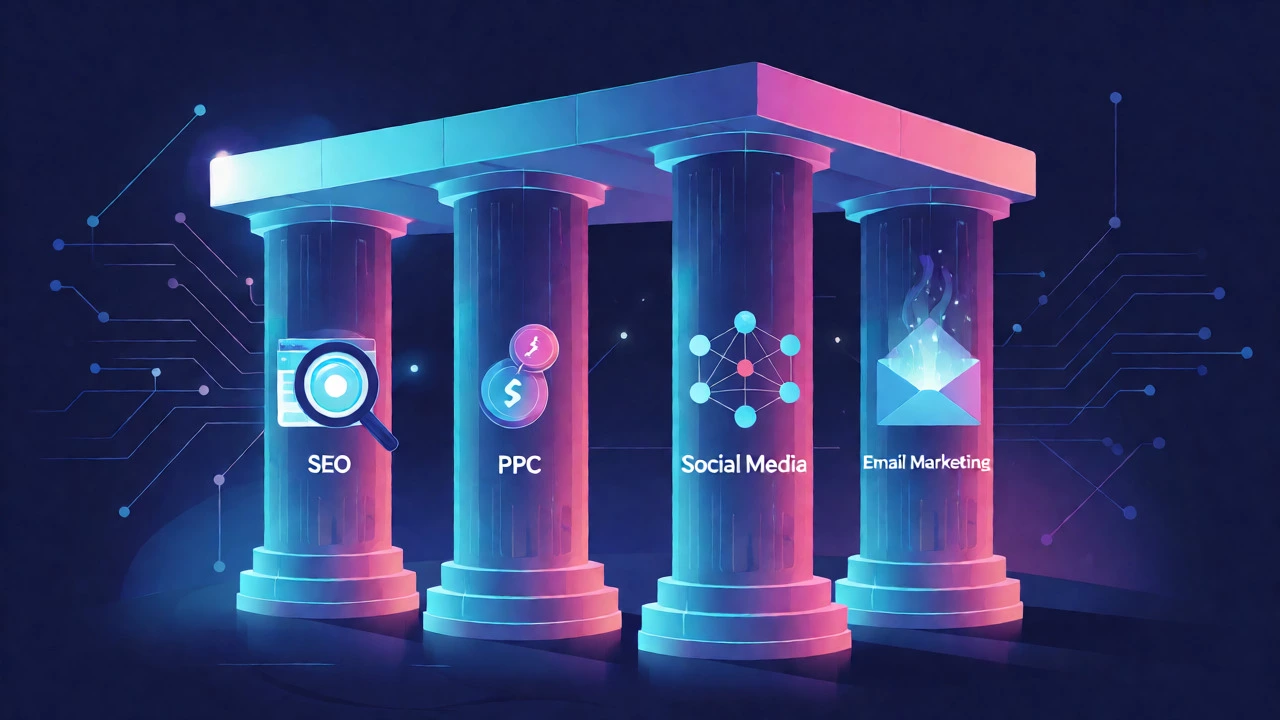
The Four Pillars You Must Master
Digital marketing is broad, but for a beginner, it boils down to four main areas. Trying to learn all sub-niches (like influencer marketing, affiliate marketing, email automation, SEO, SEM, social media, content marketing) simultaneously will burn you out. Instead, prioritize these four pillars. They cover about 80% of what most small businesses need.
A 4-Week Study Plan That Actually Works
Forget passive video watching. Active learning is the only way this works. Here is a structured approach to cramming the essentials into 30 days.
- Week 1: Foundations and SEO Basics. Spend the first three days understanding the customer journey: Awareness, Consideration, Decision. Then, dive into SEO. Use free tools like Ubersuggest or Google Keyword Planner. Pick a niche (e.g., local coffee shops). Find ten keywords with low difficulty. Write two blog posts optimized for those keywords. Don’t worry about perfection; worry about publishing.
- Week 2: Paid Traffic Experiments. Set up a Google Ads account. You don’t need a big budget-$50 is enough to learn. Create a simple campaign for your niche keywords. Track Click-Through Rate (CTR) and Cost Per Click (CPC). Simultaneously, set up a Facebook Business Manager. Create a lookalike audience based on your website visitors. Run a $5/day test ad. Analyze which image got more clicks.
- Week 3: Content and Email Funnels. Build a landing page using a tool like Carrd or WordPress. Offer a free lead magnet (e.g., a PDF checklist) in exchange for emails. Connect this to an email service provider. Write a three-email welcome sequence. Test the entire flow: Click ad → Landing Page → Email Signup → Welcome Email. Fix any broken links.
- Week 4: Analytics and Optimization. Install Google Analytics 4 and Google Tag Manager on your site. Learn to read the dashboard. Where are users coming from? Which pages have the highest bounce rate? Adjust your Week 2 ads based on this data. Pause underperforming keywords. Scale the ones that converted. Document everything in a case study format.
Tools You Need (And Can Afford)
You don’t need enterprise software. The barrier to entry is lower than ever. Many tools offer free tiers that are perfect for a one-month sprint. Using real tools gives you resume-ready skills. Employers care less about certificates and more about whether you can log in and fix a tracking issue.
| Tool Category | Recommended Tool | Why Use It | Cost |
|---|---|---|---|
| Analytics | Google Analytics 4 | Industry standard for tracking user behavior and conversions. | Free |
| SEO Research | Ubersuggest | User-friendly interface for keyword ideas and site audits. | Freemium |
| Email Marketing | Mailchimp | Easy drag-and-drop editor for building email sequences. | Free up to 500 contacts |
| Ad Management | Meta Business Suite | Central hub for managing Facebook and Instagram ads. | Free |
| Landing Pages | Carrd.co | Fast, cheap way to build simple, responsive landing pages. | $19/year |
Common Pitfalls That Waste Time
Most people fail to learn in a month because they fall into traps. First is tutorial hell. You watch twenty videos on "How to Start SEO" but never open a spreadsheet. Stop watching. Start doing. Second is ignoring mobile. Over 60% of web traffic comes from phones. If your landing page looks bad on an iPhone, you lose money. Always preview your work on mobile devices.
Another trap is chasing vanity metrics. Likes and shares feel good, but they don’t pay bills. Focus on conversions. Did someone buy? Did they sign up? Did they call? If you spent $10 on ads and got zero leads, your CTR doesn’t matter. Learn to love the boring numbers: Cost Per Lead (CPL) and Return on Ad Spend (ROAS).

Can You Get Hired After One Month?
Here is the hard truth. Getting a full-time remote job at a major agency after 30 days of self-study is rare. Why? Because trust is earned. Agencies have reputations to protect. They hire juniors who can hit the ground running, not beginners who need six months of training.
However, freelancing is different. Small business owners often lack time, not knowledge. They know they need help but don’t know how to execute. If you show them a simple report showing you increased their website traffic by 15% in a month, they might hire you. Start with friends, family, or local clubs. Offer to manage their social media or run a small ad campaign for free or at a low cost. This builds your portfolio. A portfolio with three case studies beats a certificate with no projects every time.
Beyond the Month: Keeping the Momentum
Digital marketing changes fast. Algorithms update. New platforms emerge. TikTok didn’t exist as a marketing channel five years ago. Learning in one month gets you started, but continuous learning keeps you relevant. Subscribe to newsletters like Morning Brew or Search Engine Land. Join communities on Reddit or Discord. Ask questions. Share your failures. The industry rewards curiosity and adaptability more than raw intelligence.
Don’t stop after day 30. Treat it as the foundation. Now you know the language. Next, deepen your expertise in one area. Become the "Email Guy" or the "SEO Specialist." Generalists struggle to charge premium rates. Specialists command respect. Use your initial momentum to pick a lane and drive deep.
Is a certification necessary to learn digital marketing in one month?
No, certifications are not strictly necessary for learning, though they can help with credibility. Google offers free certifications for Analytics and Ads, which are valuable additions to a resume. However, practical experience and a portfolio of actual campaigns are far more impressive to potential clients or employers than a piece of paper alone.
How much budget do I need to practice digital marketing?
You can start with very little. For SEO and content marketing, the cost is essentially zero aside from your time. For paid advertising experiments, a budget of $50 to $100 is sufficient to gather meaningful data and learn how ad platforms work. You do not need thousands of dollars to begin learning the mechanics of buying traffic.
Which digital marketing skill is easiest to learn quickly?
Social media management and basic email marketing are generally considered the easiest entry points. These skills require less technical setup than SEO or complex PPC campaigns. You can see immediate feedback from audiences and adjust your strategy in real-time, making the learning curve feel less steep for beginners.
Can I learn digital marketing without coding knowledge?
Absolutely. While knowing basic HTML helps with SEO troubleshooting, modern platforms like WordPress, Shopify, and Wix use visual builders that require no coding. Most marketing tasks involve writing copy, designing creatives, and analyzing data, none of which require programming skills.
What is the biggest mistake beginners make in their first month?
The biggest mistake is trying to master everything at once. Beginners often spread themselves too thin across SEO, PPC, Social, and Email simultaneously. This leads to shallow knowledge in all areas. It is better to go deep on one channel, achieve a small win, and then expand to others gradually.