Career Path ROI Calculator
Select your preferences to find the high-salary course with the best return on investment for your specific situation in 2026.
You want the money, but you don’t want the four-year degree grind. You’re looking for the shortcut. The path that gives you a paycheck bump without burying you in student debt or requiring a PhD in quantum physics. It’s a fair question. In 2026, the gap between what companies pay and what they require to get hired is wider than ever. Technology shortages, aging tradespeople, and a shift toward remote work have created specific "sweet spots" where low barriers to entry meet high market demand.
But here is the hard truth first: there is no such thing as an "easy" job that pays well if you define easy as "no effort." However, there are definitely job-oriented courses that are straightforward, logical, and can be completed in months rather than years. These paths rely on learning a specific skill set-often digital or technical-that employers are desperate for right now. Let’s look at the real options that fit this description.
The Tech Route: Coding Without the Computer Science Degree
When people hear "tech," they think of Silicon Valley engineers making six figures after studying algorithms for four years. That’s one path. But there is another side of tech that is much more accessible. We are talking about roles that focus on implementation and management rather than deep theoretical computer science.
Another option is becoming a QA (Quality Assurance) Tester. Before any app or website goes live, someone has to break it. This role requires attention to detail and logical thinking, not necessarily advanced math. You learn testing methodologies, write bug reports, and use automation tools. Many bootcamps offer QA certifications in 12 weeks. It’s a foot in the door for the tech industry, which then allows you to pivot into higher-paying development roles later if you choose.
Digital Marketing: The Performance-Based Path
If you prefer talking to people and analyzing trends over staring at code, digital marketing is your playground. Specifically, look at Pay-Per-Click (PPC) Advertising, which is a model of internet marketing in which advertisers pay a fee each time one of their ads is clicked. Every business needs customers. If you can show them how to spend $1 to make $5 back, you will never go hungry.
Google Ads and Meta (Facebook/Instagram) advertising platforms offer free certifications. These aren't degrees; they are practical tests that prove you know how to set up campaigns, target audiences, and read analytics. Once certified, you can freelance or join an agency. Entry-level PPC specialists often start at $50,000, but those who master conversion rate optimization (CRO) quickly push past $90,000. The barrier to entry is low because all you need is a laptop and an internet connection. The "difficulty" here isn't academic; it's psychological. You have to be comfortable with failure, because half your ad tests will flop. But the learning curve is steep and rewarding.
The Trade Shortcut: HVAC and Solar Installation
We often forget that "courses" don't always mean sitting at a desk. In 2026, the green energy transition is creating a massive labor shortage. Solar Panel Installation is the process of mounting solar panels on rooftops or ground mounts to generate electricity from sunlight. This is physically demanding, yes, but intellectually, it is straightforward. You learn safety protocols, electrical basics, and mounting techniques. Most trade schools offer programs that last between six months and a year.
Why is this high salary? Because supply is low and demand is skyrocketing due to government incentives and rising electricity costs. An entry-level solar technician can earn $45,000 to $60,000 starting out, with overtime pushing that significantly higher. Similarly, HVAC (Heating, Ventilation, and Air Conditioning) repair is recession-proof. People will always need their AC fixed in summer and heat in winter. Certification programs are short, hands-on, and lead directly to employment. There is no "degree inflation" here; your license is your ticket.
Project Management: Organizing Chaos
If you are naturally organized and good at communicating, consider Project Management. Specifically, the CAPM (Certified Associate in Project Management) or PMP (Project Management Professional) certifications. While PMP requires experience, CAPM is designed for beginners. You study a standardized framework for planning, executing, and closing projects.
This skill is universal. Construction firms, software companies, hospitals, and marketing agencies all need project managers. The course material is dry-it’s mostly memorizing processes and terminology-but it is not "hard" in the sense of being abstract or difficult to grasp. It’s logical. A junior project coordinator can start at $60,000, and with a few years of experience and the PMP cert, salaries jump to $100,000+. The key here is soft skills. You aren't doing the work; you are ensuring others do the work on time. If you hate conflict, this might not be for you. But if you like structure, it’s a goldmine.
Cloud Computing Basics: The New Office Job
The cloud isn't going anywhere. AWS (Amazon Web Services), Azure (Microsoft), and Google Cloud are the backbone of modern business. You don't need to be a network engineer to benefit from this. Look into AWS Certified Cloud Practitioner, which is an foundational level certification that validates overall understanding of the AWS Cloud platform. This exam covers billing, security, and core services. It is widely considered one of the easiest cloud certs to pass. Study guides are abundant, and many people pass within two months of part-time study.
With this cert, you qualify for roles like Cloud Support Associate or Junior Cloud Administrator. These roles involve monitoring systems, handling basic tickets, and ensuring uptime. Starting salaries hover around $70,000. As you learn more specialized services (like serverless computing or machine learning APIs), your value skyrockets. The beauty of cloud computing is that the tools are web-based. You can practice from home. No expensive lab equipment needed.
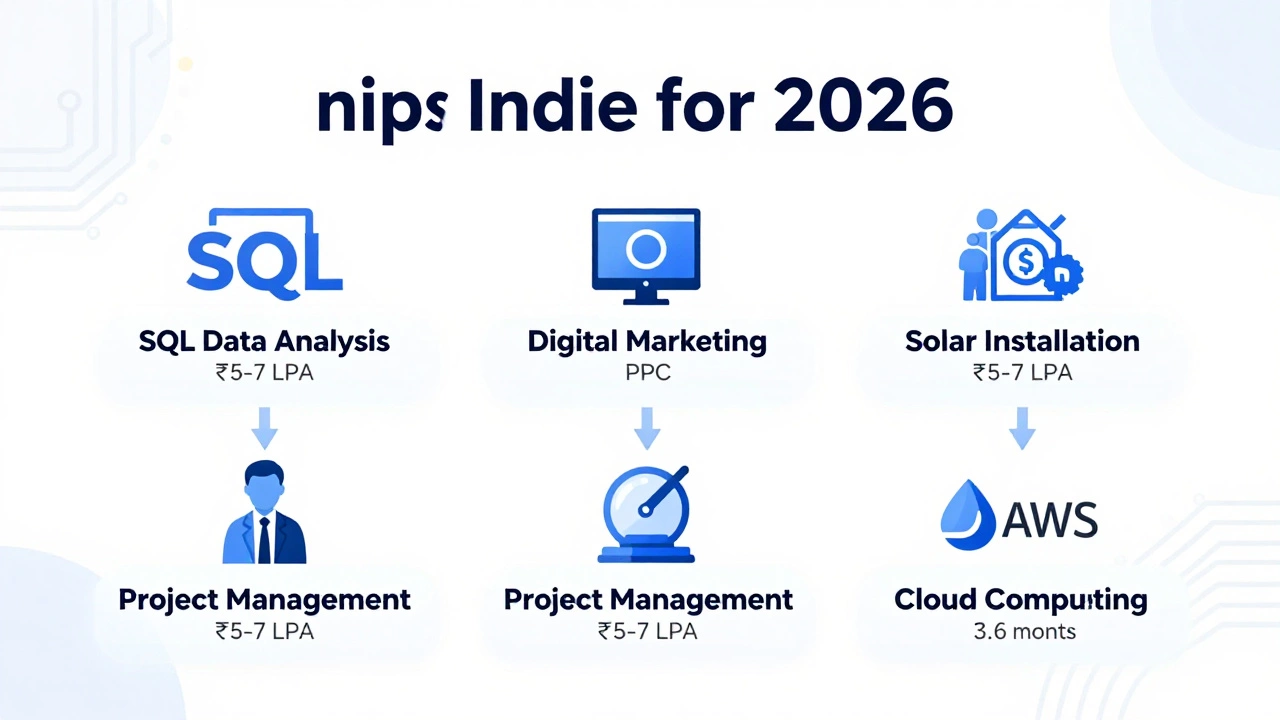
| Course/Certification | Time to Complete | Estimated Cost | Starting Salary Range | Difficulty Level |
|---|---|---|---|---|
| SQL & Data Analysis | 3-6 Months | $500 - $2,000 | $65k - $80k | Low-Medium |
| Google/Meta Ads Cert | 1-2 Months | Free - $500 | $50k - $70k | Low |
| Solar Installation Trade | 6-12 Months | $5,000 - $10,000 | $45k - $60k+ | Medium (Physical) |
| CAPM Project Mgmt | 3-4 Months | $300 - $1,000 | $60k - $75k | Low (Memorization) |
| AWS Cloud Practitioner | 2-3 Months | $100 - $500 | $70k - $85k | Low-Medium |
How to Choose: A Decision Framework
Don't just pick the one with the highest number. Pick the one that fits your brain. Ask yourself these three questions:
- Do I prefer logic or people? If logic, go SQL or Cloud. If people, go Digital Marketing or Project Management.
- Am I willing to get my hands dirty? If yes, trades like Solar or HVAC offer incredible stability and less competition from college grads.
- What is my timeline? If you need money next month, look for freelance digital marketing gigs. If you have six months, invest in a trade or cloud cert.
Avoid "diploma mills" that promise riches for a generic "Business Administration" certificate. Those are saturated. Focus on hard skills. Can you run a query? Can you set up an ad campaign? Can you wire a panel? These are tangible outputs that employers can test for immediately.
Pitfalls to Avoid
Be wary of courses that cost more than $5,000 unless they include a job guarantee or apprenticeship. For most of the certifications listed above, self-study resources, YouTube tutorials, and official vendor exams are sufficient. You don't need a fancy campus. Also, remember that "easiest" is relative. If you struggle with math, SQL might feel hard. If you hate reading, Project Management texts might bore you. The "easiest" course is the one that aligns with your natural strengths. Leverage what you already know. If you were good at organizing school events, try Project Management. If you liked helping friends fix their phones, try IT support or Cloud basics.
Is a college degree still necessary for high salaries?
Not always. In fields like tech, digital marketing, and skilled trades, portfolios and certifications often outweigh degrees. Employers care more about whether you can do the job. However, some corporate HR filters still automatically reject non-degree holders. To bypass this, build a strong portfolio of real-world projects or gain initial experience through internships or freelance work.
Which certification is truly the easiest to pass?
The Google Digital Garage Fundamentals of Digital Marketing and the AWS Cloud Practitioner exam are widely considered the easiest entry points. They are multiple-choice, cover broad concepts rather than deep technical details, and have abundant free study materials available online.
Can I really make $100k+ with just a certificate?
Yes, but usually not on day one. The certificates get you the interview. The salary comes from performance and specialization. For example, a junior SQL analyst starts at $65k, but a Senior Data Engineer who specializes in big data tools (like Spark or Hadoop) can easily clear $120k. The certificate is the key, but continuous learning unlocks the higher brackets.
Are trade jobs physically too demanding?
They can be. Solar installation involves working on roofs in heat. HVAC involves crawling in attics. However, they offer physical activity which many desk-job seekers miss. Also, as you gain experience, you often move into supervisory or estimation roles, which are less physically taxing but pay even more.
How long does it take to find a job after certification?
It varies by market and economy. In high-demand areas like tech hubs, you could land a role in 1-3 months. In slower markets, it might take 6 months. Networking is crucial. Don't just apply online; connect with alumni from your course, join LinkedIn groups, and attend local meetups. Referrals hire faster than cold applications.