
Computer Course Path Finder
Answer a few questions to find the most suitable learning path based on your current situation.
Recommended Path:
Thinking about jumping into tech but not sure if you have three months or three years to spare? You aren't alone. The biggest headache when looking for computer courses india is that "computer course" could mean anything from a weekend workshop on Excel to a four-year engineering degree. If you're trying to pivot your career or just add a skill to your resume, the clock is ticking, and you need to know exactly how much of your life this will consume.
Quick Duration Cheat Sheet
Before we break down every single path, here is the fast version. If you're in a rush, use this as your compass.
| Course Type | Typical Duration | Goal |
|---|---|---|
| Short-term Certification | 2 weeks to 3 months | Specific tool mastery (e.g., Python) |
| Diploma Courses | 6 months to 2 years | Job-ready vocational skills |
| Bootcamps | 3 to 6 months | Intensive career pivot |
| Bachelor's Degree | 3 to 4 years | Comprehensive theoretical foundation |
Short-Term Certifications: The Sprint
If you just need to learn how to use a specific piece of software or a single programming language, you're looking at a "sprint." These courses are usually focused on one specific Skill. For example, if you take a course on Advanced Excel or a basic Python crash course, you can wrap it up in 4 to 12 weeks.
Most of these programs in India are delivered via platforms like Coursera, Udemy, or local training centers in hubs like Bengaluru or Hyderabad. You'll typically spend 5 to 10 hours a week. The goal here isn't to become a computer scientist; it's to get a certificate that proves you can handle a specific task. If you're an accountant who wants to automate reports, a 2-month Python course is plenty.
Diploma Courses: The Middle Ground
A Diploma in Computer Science is a different beast. These are essentially vocational bridges. They don't take as long as a degree, but they offer way more depth than a certificate. In India, diplomas usually last between 6 months and 2 years.
Why choose this? Because it's designed for people who want to enter the workforce quickly. You'll spend less time on the history of computing and more time on actual implementation. For instance, a Diploma in Web Development might spend 6 months teaching you HTML, CSS, and JavaScript, and another 6 months on backend frameworks like Node.js or Django. It's a heavy lift, but it gets you job-ready without spending four years in a classroom.
Coding Bootcamps: The Intensity Play
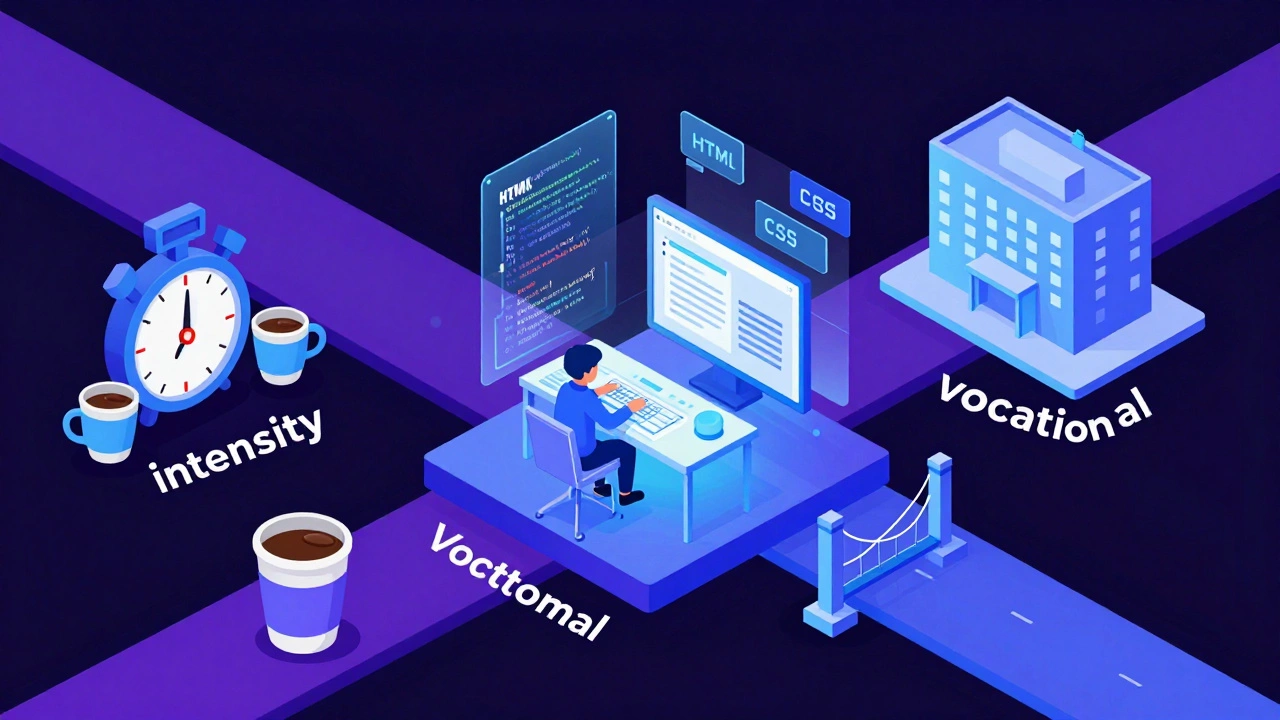
Bootcamps are the "special forces" of tech education. They are designed to take someone from zero to "employable developer" in a ridiculously short window-usually 12 to 24 weeks. But don't let the short timeframe fool you. While a degree is a marathon, a bootcamp is a high-intensity interval training session.
You'll likely be studying 40 to 60 hours a week. You won't be reading textbooks about how a CPU works; instead, you'll be building actual apps. In India, bootcamps often focus on "Full Stack" development. This means you learn both the front-end (what the user sees) and the back-end (where the data lives). If you have a high tolerance for stress and a lot of free time, this is the fastest way to a high-paying tech job.
Academic Degrees: The Long Game
Then there is the traditional route. A B.Tech in Computer Science or a BCA (Bachelor of Computer Applications) takes 3 to 4 years. This is for the person who wants to understand the "why" behind the "how."
You'll dive into Data Structures and Algorithms, operating systems, and discrete mathematics. While a bootcamp teaches you how to build a website, a degree teaches you how the internet actually works and how to optimize a database for millions of users. It's a massive time commitment, but it's still the gold standard for getting into top-tier companies like Google or Microsoft in India, where the degree often acts as the first filter in the hiring process.
Factors That Change Your Timeline
Not every student moves at the same speed. Your actual completion date will depend on a few variables:
- Prior Knowledge: If you already know basic logic or have dabbled in HTML, you can often breeze through the first month of any course.
- Learning Format: Self-paced online courses can be finished in two weeks if you're a machine, or six months if you're working a full-time job. Instructor-led courses have a fixed end date.
- Project Requirements: Some diplomas require a final "capstone project." Building a simple calculator takes an hour; building a functional e-commerce site can take three months.
- Intensity Level: Part-time courses (evenings/weekends) naturally double the calendar duration compared to full-time immersive programs.
Which Path Fits Your Life?
Choosing the right course length is really about balancing your urgency with your goals. If you're currently unemployed and need a job tomorrow, a 3-month bootcamp or a fast-track certification is your best bet. You take the risk of a shallower knowledge base in exchange for speed.
If you're a student planning your future, the 4-year degree is the safest bet. It provides a network, a recognized credential, and a broad base of knowledge that makes you adaptable when the next big trend (like AI) hits. If you're already working and just want to be more efficient, stick to the short-term certifications.
Can I learn coding in 3 months and get a job?
Yes, but it's difficult. This usually requires a high-intensity bootcamp where you study 10+ hours a day. You'll be job-ready for junior roles, but you'll need a strong portfolio of projects to prove your skills since you won't have a degree.
Is a BCA better than a B.Tech for computer science?
It depends on your goal. A B.Tech is more engineering-focused and usually more respected by high-end tech firms. A BCA is more application-focused and often takes 3 years instead of 4, making it a faster route to the industry.
Do online certifications count as much as diplomas?
Generally, no. A diploma is a formal qualification that implies a structured curriculum and assessment. Online certificates show you're a self-starter and have specific knowledge, but they rarely replace a formal diploma or degree in a formal hiring process.
How long does it take to learn a programming language from scratch?
To get the basics (syntax, loops, functions), it takes about 4 to 8 weeks of consistent study. However, to become proficient enough to build a real-world application, expect to spend 6 months to a year of daily practice.
What is the fastest computer course for non-tech people?
Basic Computer Literacy or Digital Literacy courses are the fastest, often taking only 2 to 4 weeks. These cover the essentials like operating systems, email, and basic office software.
Next Steps for Your Tech Journey
If you're still undecided, start with a free "Introduction to Computer Science" course online. This will tell you if you actually enjoy the logic of coding before you commit years of your life or thousands of rupees to a formal program. Once you know you like it, map out your timeline based on your financial situation and how quickly you need to start earning.