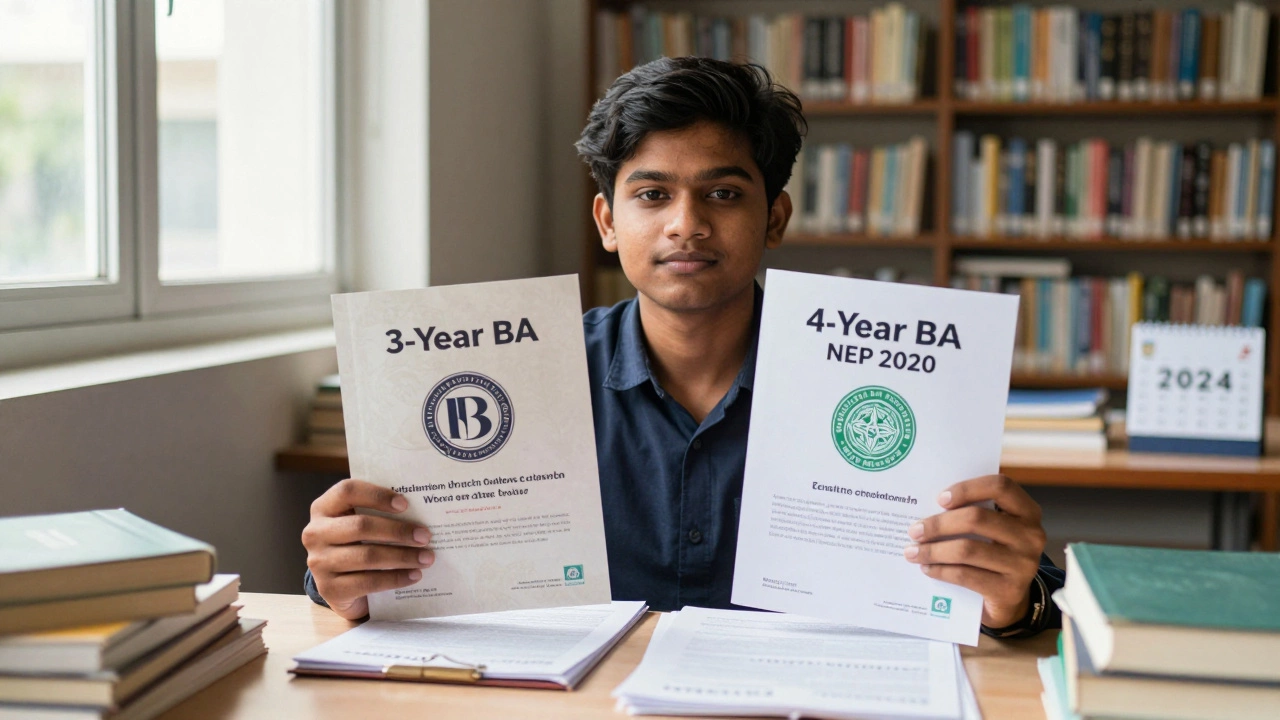
BA Program Selector: Which Degree Is Right for You?
Choose the right BA program for your goals with this quick assessment tool. Answer a few questions to see which program aligns with your career plans, budget, and timeline.
When you hear BA, you might think it’s just a three-year degree. But in India in 2024, the answer isn’t that simple. The length of a Bachelor of Arts degree depends on where you study, what you major in, and whether your college follows the old system or the new National Education Policy (NEP 2020). Many students get confused because some colleges still say it’s three years, while others say four. So how long is a BA in 2024? Let’s clear this up once and for all.
Traditional BA: The Three-Year Model
For decades, the standard BA in India was a three-year program. That’s still true in most government colleges and older private institutions. You’d pick a major-like History, Political Science, or English-and take courses in that subject plus a few electives and general papers. The structure was simple: six semesters, exams at the end of each, and graduation after three years.
Many students still follow this path, especially in smaller towns and rural areas where NEP changes haven’t fully rolled out. If you’re looking at a college that hasn’t updated its website since 2018, chances are they’re still offering the traditional three-year BA.
NEP 2020: The Four-Year BA
In 2020, India’s National Education Policy introduced major changes to undergraduate degrees. Under NEP, a BA can now be a four-year program with more flexibility. This isn’t just an extension-it’s a complete redesign.
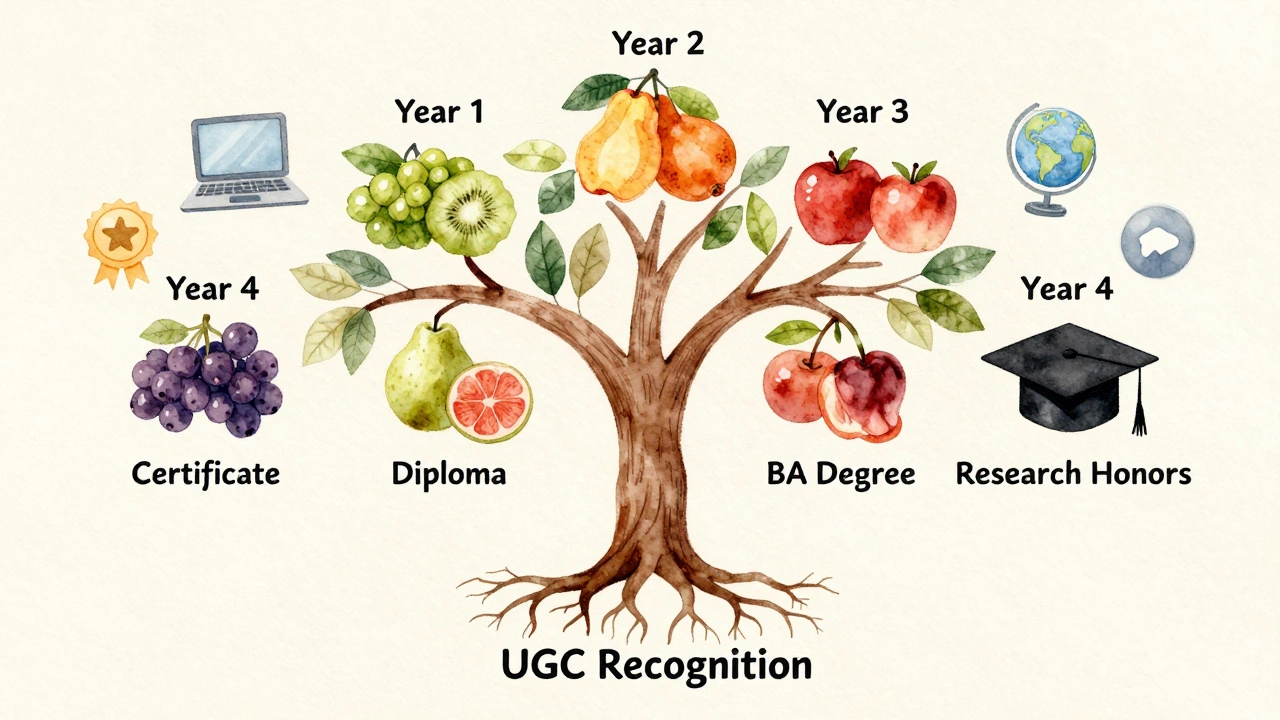
The four-year BA lets you:
- Exit after three years with a regular BA degree
- Exit after two years with a diploma
- Exit after one year with a certificate
- Continue to four years for an honors degree with research
This means you can leave early if you need to work or change direction. But if you stay the full four years, you get a more in-depth degree. The fourth year usually includes a research project, internship, or capstone paper. It’s designed to make graduates more job-ready.
Colleges like Delhi University, Christ University, and Ashoka University have already switched to the four-year model. But not every college has made the change yet. So when you apply, check the prospectus carefully.
What’s the Difference Between Three-Year and Four-Year BA?
It’s not just about time. The curriculum changes too.
| Feature | Three-Year BA | Four-Year BA (NEP) |
|---|---|---|
| Duration | 3 years | 4 years |
| Exit options | Only after 3 years | Exit after 1, 2, or 3 years |
| Research component | Minimal or none | Required in Year 4 |
| Internships | Usually optional | Often mandatory |
| Eligibility for PG | Yes | Yes, but four-year is preferred |
| Recognition | Widely accepted | Recognized by UGC and all universities |
Employers and universities now favor the four-year BA, especially for competitive fields like journalism, public policy, or international relations. Many top universities in India now require a four-year undergraduate degree for admission to their master’s programs.

Does Your Major Affect the Length?
Yes. While most BA majors follow the same timeline, some programs have special rules.
For example:
- BA in English Literature - Usually three years in traditional colleges, but four years under NEP with a focus on literary theory and creative writing projects.
- BA in Journalism - Often includes mandatory internships, making the four-year version more valuable.
- BA with Honors - Even in three-year colleges, honors programs are more intense and may feel longer because of extra papers and projects.
- BA in Foreign Languages - Some colleges offer five-year integrated BA+MA programs in languages like French, German, or Chinese. These are different from standard BAs.
If you’re interested in English courses specifically, the four-year BA gives you more time to develop advanced writing, critical analysis, and public speaking skills. That’s a big advantage if you want to work in content, teaching, or media.
What Happens If You Don’t Finish in Four Years?
Most colleges allow up to six years to complete a four-year BA. Life happens-health issues, financial delays, family responsibilities. The system is designed to be flexible. You can take breaks, retake failed courses, or switch majors within the first two years without losing your progress.
But don’t wait too long. If you’re more than two years behind, some colleges may ask you to reapply or restart certain components. Always check your college’s academic regulations.
How to Know Which BA You’re Enrolling In
Don’t assume. Always check the official website or ask for the prospectus. Here’s what to look for:
- Look for the phrase “under National Education Policy 2020” or “4-year UG program”.
- Check the course structure-does it mention research, internships, or exit options?
- Call the admissions office and ask: “Is this a 3-year or 4-year BA under NEP?”
- Look at the fee structure-four-year programs often cost more, especially if they include internships or international exchanges.
If the college doesn’t mention NEP at all, it’s likely still running the old system. That’s not wrong-it’s just different.
Should You Choose a Three-Year or Four-Year BA?
It depends on your goals.
Choose a three-year BA if:
- You want to enter the job market quickly
- You’re unsure about your career path and want to test the waters
- You’re on a tight budget and need to save on tuition
- You plan to switch to a vocational course or certification after graduation
Choose a four-year BA if:
- You want to go to graduate school (MA, MBA, MSc)
- You’re aiming for government jobs that prefer or require four-year degrees
- You want to build strong research or writing skills
- You’re interested in careers in education, media, NGOs, or public policy
Many students who start with a three-year BA later enroll in a one-year postgraduate diploma to make up for the gap. But that costs more time and money. Starting with the four-year option can save you both.
What About Recognition and Validity?
Both degrees are valid. The University Grants Commission (UGC) recognizes both three-year and four-year BAs. But here’s the catch: many top employers and universities now list “four-year undergraduate degree preferred” in their job postings.
For example, the Indian Administrative Service (IAS) exam doesn’t require a four-year degree-but many coaching institutes now recommend it because the syllabus matches better with the broader curriculum.
If you’re applying abroad, the four-year BA is more likely to be seen as equivalent to a standard bachelor’s degree in the US, UK, or Canada. Three-year degrees from India are sometimes questioned by foreign universities, especially for master’s admissions.
Final Answer: How Many Years Is a BA in 2024?
In 2024, a BA in India can be either three or four years long. The three-year version still exists but is becoming less common in top institutions. The four-year BA under NEP 2020 is the new standard for students who want depth, flexibility, and better career prospects.
If you’re choosing a college today, aim for the four-year program. It gives you more options, better skills, and stronger recognition. But if cost or time is a barrier, the three-year BA is still a valid path-you just need to plan your next steps carefully.
Don’t just pick the shortest route. Pick the one that gives you the most room to grow.
Is a 3-year BA still valid in India in 2024?
Yes, a three-year BA is still valid and recognized by the UGC. However, many universities and employers now prefer the four-year BA under NEP 2020 because it includes more depth, internships, and research. If you’re planning to pursue higher studies or competitive jobs, the four-year degree gives you a stronger edge.
Can I do a BA in English in 3 years?
Yes, you can complete a BA in English in three years at colleges that haven’t adopted the NEP 2020 system. But if you want advanced training in literary analysis, creative writing, or media communication, the four-year BA offers more time to develop those skills through electives, internships, and research projects.
Does a 4-year BA cost more than a 3-year BA?
Generally, yes. Four-year programs often have higher tuition fees because they include additional components like internships, research projects, and sometimes international exposure. However, many colleges offer scholarships or installment plans. Also, the long-term value-better jobs, higher salaries, and access to top PG programs-often outweighs the initial cost.
Can I switch from a 3-year BA to a 4-year BA later?
No, you can’t switch mid-way. Once you enroll in a three-year program, you complete it as designed. But if you finish your three-year BA and later want to upgrade, you can enroll in a one-year postgraduate diploma or certificate course to gain additional skills. Some universities also offer lateral entry into master’s programs for three-year BA holders.
Is a 4-year BA better for jobs in India?
Yes, increasingly so. Companies in media, education, NGOs, and government sectors are starting to prefer candidates with four-year degrees because they’ve had more time to develop critical thinking, communication, and practical experience. For roles like content writer, HR executive, or public relations officer, the extra year makes a real difference in readiness.