
Career Path Comparison Calculator
Compare Your Career Path Options
Calculate the financial and time investment of certificate vs degree programs based on India's current job market.
When you're trying to get ahead in your career in India, you’ve probably heard the same question over and over: certificate or degree? It’s not just about what looks good on paper-it’s about what gets you hired, what pays off faster, and what actually fits your life.
Let’s be real. A four-year degree used to be the golden ticket. But things have changed. In 2026, companies across India-from Bengaluru startups to Mumbai fintech firms-are hiring based on what you can do, not just what you studied. And that’s where certificates come in.
What’s the real cost of a degree?
A full-time undergraduate degree in India can cost anywhere from ₹3 lakh to ₹15 lakh, depending on the college and course. Add living expenses, books, and lost income from not working, and you’re looking at over ₹20 lakh in total investment. Most students graduate with debt. And even then, many end up in jobs unrelated to their degree.
Compare that to a certificate course. A six-month digital marketing certification from a reputable provider like Simplilearn or upGrad costs around ₹25,000 to ₹60,000. A six-week Python for data analysis course? As low as ₹8,000. You can finish it while working part-time. No loans. No lost salary. Just skills you can start using next week.
Who’s hiring certificates now?
It’s not just startups. Big names are shifting. TCS hires certificate holders for roles in cloud computing and cybersecurity. Infosys has a dedicated track for certified AI and automation specialists. Even government agencies like NIC and UIDAI now accept NASSCOM-certified professionals for technical roles.
In manufacturing, companies like Maruti Suzuki and Tata Motors train workers through NSDC-certified programs in robotics maintenance. In healthcare, nursing assistants with certificate training from the National Skill Development Corporation are now preferred over diploma holders in rural clinics because they’re trained on actual equipment used in the field.
Why? Because certificates are tied to specific, industry-recognized skills. You don’t learn theory-you learn how to run Google Ads, configure a firewall, or use SAP S/4HANA. Employers know exactly what they’re getting.
Time matters more than you think
At 22, you have two choices: spend four years in college or get certified and start earning in six months. That’s not just faster-it’s financially smarter.
Let’s say you start a certificate course in graphic design after Class 12. You finish in 4 months. You land a freelance gig at ₹15,000/month. By the time your friend graduates with a BA in Arts, you’ve earned ₹7.2 lakh. You’ve also built a portfolio, client base, and real-world experience. Your friend is still applying for entry-level jobs.
Time is the one resource you can’t get back. Certificates give you speed. Degrees give you tradition.

Are degrees useless now?
No. But they’re not always the best path.
If you want to become a doctor, engineer, lawyer, or chartered accountant-you still need a degree. These are regulated professions. The law requires it. No certificate will let you practice medicine or sign off on legal documents.
But if you’re aiming for roles in digital marketing, content creation, data analysis, UI/UX design, cybersecurity, or even project management-you don’t need a degree. You need proof of skill. And that’s what a certificate gives you.
Think of it this way: a degree is like a passport. It says you’ve been through a system. A certificate is like a visa. It says you’ve cleared a specific checkpoint-and you’re ready to work.
What certificates actually matter in India?
Not all certificates are equal. Some are just PDFs with a logo. Others are backed by industry giants.
Here are the ones that actually open doors in 2026:
- NASSCOM FutureSkills Prime - Recognized by 500+ tech companies. Covers AI, cloud, cybersecurity.
- Google Career Certificates - Project Management, Data Analytics, UX Design. Accepted by Microsoft, Verizon, and Indian IT firms.
- Microsoft Learn Certifications - Azure Fundamentals, Power BI, Dynamics 365. Used by banks and government IT projects.
- NSDC Certifications - Under PMKVY, covers hospitality, retail, healthcare support roles.
- UpGrad & Simplilearn Certificates - In-demand for digital marketing, data science, and product management roles.
These aren’t just online quizzes. They include live projects, mentorship, and placement support. Many come with job guarantees or internships.
The hidden advantage: flexibility
Life doesn’t wait. Maybe you’re a single parent. Maybe you’re working a job to support your family. Maybe you dropped out of college and want to restart.
Certificates let you learn on your schedule. You study after your shift. You pause when your kid is sick. You finish in 3 months instead of 4 years. No rigid semesters. No attendance rules. No pressure to conform.
And here’s the kicker: employers notice this. They see someone who took initiative. Who didn’t wait for permission to grow. That’s the kind of person they promote.
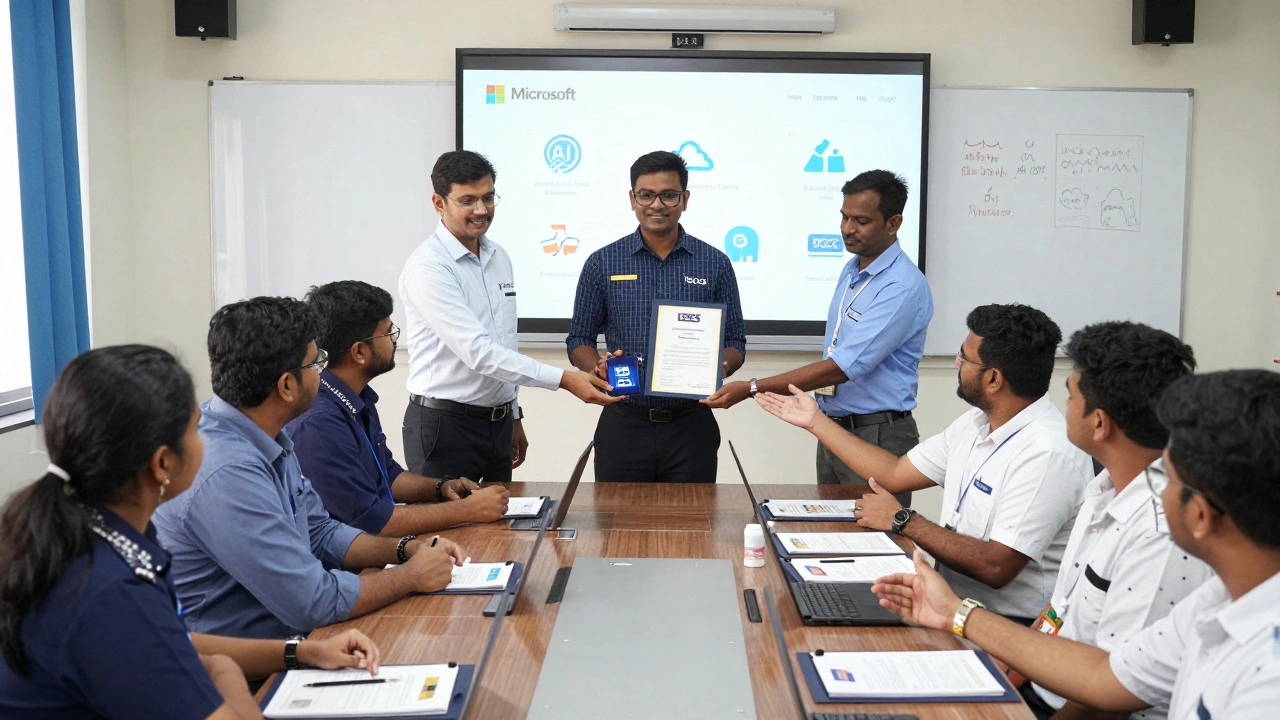
What about promotions and long-term growth?
Some say, “Degrees help you climb the ladder.” That used to be true. But now? It’s changing fast.
In IT, a senior developer with a Google Data Analytics certificate can earn more than a BA graduate with no certifications. In sales, someone with a HubSpot Inbound Marketing certification leads teams at top Indian SaaS companies.
Large organizations like Accenture and Deloitte now have internal certification ladders. You start with a certificate, move to a specialization, then earn a leadership credential-all without going back to college.
Even in government jobs, the new skill-based recruitment model under the National Education Policy 2020 gives preference to certified candidates for non-technical roles.
So, which should you choose?
Here’s how to decide:
- Check the job description. If it says “degree preferred,” it’s probably a corporate or regulated role. If it says “certification in [skill] required,” go for the certificate.
- Look at the salary range. Entry-level roles for certified candidates in tech often pay ₹3-5 lakh/year. Degree holders in non-tech fields might start at ₹2-3 lakh.
- Ask hiring managers. On LinkedIn, message recruiters in your target industry. Ask: “What certifications do your top performers have?” You’ll get honest answers.
- Consider your timeline. Need income in 6 months? Certificate. Want to become a professor or researcher? Degree.
The truth? You don’t have to pick one. Many professionals now do both. They earn a certificate while working, then pursue a part-time degree later. But the certificate gets them in the door. The degree, if they need it, comes after.
Final thought: Skills beat paper
In 2026, your resume isn’t judged by the name of your college. It’s judged by what you can build, fix, write, or automate.
A certificate proves you’ve done the work. A degree proves you’ve sat through lectures. One gets you hired. The other gets you a diploma.
Choose the path that matches your goals-not the one society told you to follow.
Are certificate courses in India recognized by employers?
Yes, especially from recognized providers like NASSCOM, Google, Microsoft, NSDC, and upGrad. Many Indian companies, including TCS, Infosys, and Flipkart, actively hire candidates with these certifications. Government schemes like PMKVY also validate these credentials for job placements.
Can I get a job with just a certificate and no degree?
Absolutely. In tech, digital marketing, data analysis, and skilled trades, employers care more about your ability to perform the job than your educational background. Many entry-level roles in IT support, content creation, and customer analytics now list certifications as the primary requirement.
Which certificate courses have the highest ROI in India?
Based on 2025 job market data, the top ROI certificates are: Google Data Analytics, NASSCOM AI & Machine Learning, Microsoft Azure Fundamentals, HubSpot Inbound Marketing, and NSDC-certified roles in healthcare support and retail operations. These lead to starting salaries of ₹3.5-6 lakh/year with strong growth paths.
Do certificate courses help with government jobs in India?
For technical and non-gazetted roles, yes. Under the National Education Policy 2020, many state and central government departments now prioritize NSDC and NASSCOM-certified candidates for positions in IT, data entry, digital literacy, and public service support roles. However, for Class I or engineering posts, a degree is still mandatory.
Is it worth doing a certificate course while studying for a degree?
Definitely. Many students combine a degree with a certificate in a high-demand skill like digital marketing or Python programming. This makes them stand out in campus placements. Employers see it as initiative and practical focus. It’s the best of both worlds: theory from college, real skills from certification.