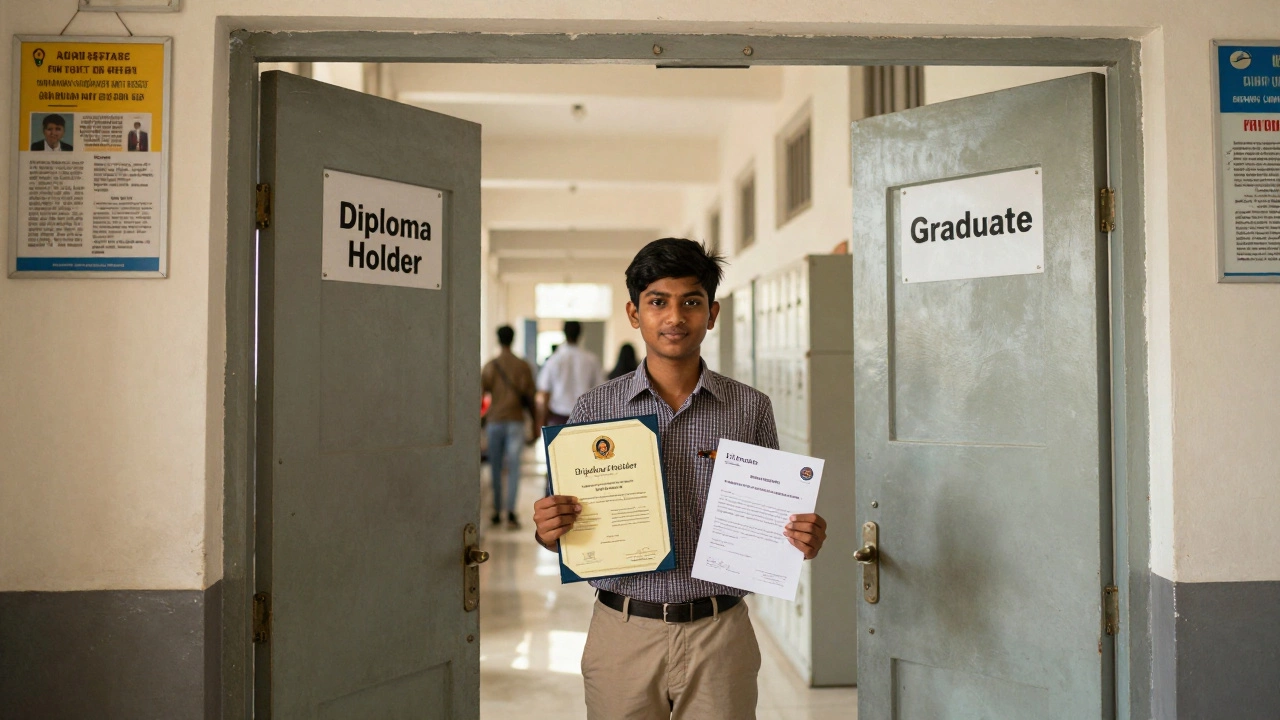
Many people in India assume that earning a diploma means you’re a graduate. It’s a common misunderstanding-one that can cost you job opportunities, admission to higher education, or even promotion. The truth is simple: diploma is not a graduate degree in India. But why does this confusion exist? And what does it actually mean if you have a diploma?
What Is a Diploma in India?
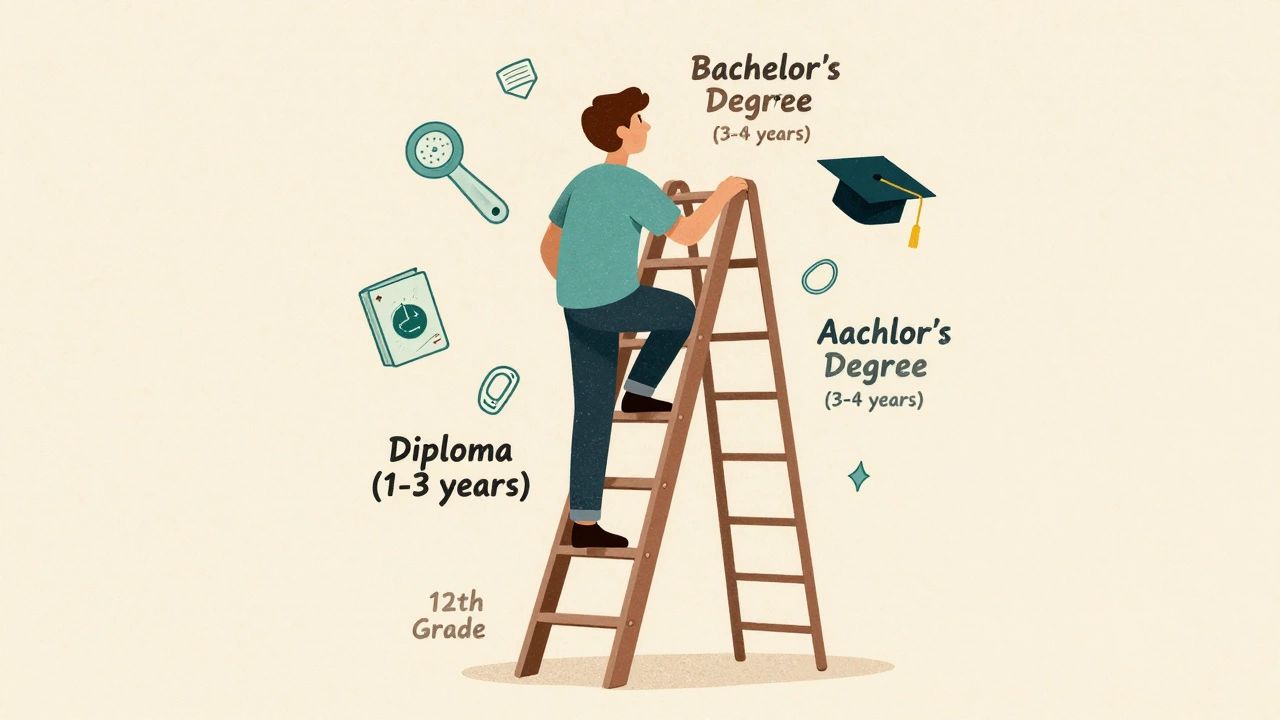
A diploma in India is a short-term, skill-focused program that usually lasts between one and three years. It’s designed to give you hands-on training in a specific trade or technical field. You’ll find diplomas in areas like mechanical engineering, computer science, nursing, civil engineering, hotel management, and electronics. These are offered by polytechnics, industrial training institutes (ITIs), and some universities.Unlike degrees, diplomas don’t require you to complete 12th grade with a full academic curriculum. Many students enter diploma courses right after 10th grade. That’s one reason why people think it’s a "higher" level than it actually is. But completing a diploma doesn’t make you a graduate. It makes you a diploma holder.
What Counts as a Graduate Degree in India?
In India, "graduate" means you’ve completed a bachelor’s degree-like B.A., B.Sc., B.Com., or B.Tech. These programs take three to four years after 12th grade. They’re more theoretical, broader in scope, and recognized by the University Grants Commission (UGC) or All India Council for Technical Education (AICTE).Graduate degrees are the baseline requirement for most government jobs, postgraduate studies (like M.A. or M.Tech), and many private sector roles. If a job posting says "graduate required," they’re asking for a bachelor’s degree-not a diploma.
Why the Confusion?
The confusion comes from how diplomas are marketed. Some institutions call their three-year diploma programs "post-secondary" or "higher diploma," which sounds impressive. Others use phrases like "equivalent to graduation" in brochures. That’s misleading. The government doesn’t recognize diplomas as equivalent to graduation.Even the AICTE, which regulates technical education, clearly states that a diploma is a level below a bachelor’s degree. It’s a stepping stone, not a destination. Many diploma holders go on to complete a bachelor’s through lateral entry-jumping into the second year of a B.Tech or B.E. after their diploma. That’s because the system acknowledges the value of the training, but still treats it as preparatory, not equivalent.
Real-World Consequences of Mixing Up Diploma and Graduate
I’ve seen too many cases where someone with a diploma applies for a government job that requires a graduate degree-and gets rejected because their documents don’t match. One young man from Lucknow spent six months preparing for a state police constable exam, only to find out his diploma in mechanical engineering didn’t qualify him. He had to start over with a B.A. after working for two years.Similarly, if you want to study abroad, most universities in the UK, Australia, or Canada won’t accept a diploma as equivalent to a bachelor’s. You’ll need to complete a top-up program or go back to square one with a full degree.
Even in private companies, HR systems often filter out diploma holders for roles labeled "graduate level." You might be more skilled than a graduate with no experience, but the system doesn’t see it that way.
Can a Diploma Lead to a Graduate Degree?
Yes-and that’s where the real value lies. After completing a diploma, you can enter a bachelor’s program through lateral entry. For example:- Diploma in Engineering → 2nd year of B.Tech/B.E. (via LEET or state entrance exams)
- Diploma in Pharmacy → 2nd year of B.Pharm
- Diploma in Nursing → B.Sc. Nursing (in some states)
This is a smart path. You save time and money. You get practical experience before diving into theory. Many top engineers in India started with a diploma. But again-this doesn’t make the diploma itself a graduate degree. It’s a bridge to one.
What About Certificate Courses?
Certificate courses are even shorter-usually 3 to 12 months. They’re great for learning a specific tool or skill, like Excel, AutoCAD, or digital marketing. But they’re not even at the same level as a diploma. Don’t confuse certificates with diplomas, and don’t assume either equals graduation.How to Prove You’re a Graduate
If you want to be recognized as a graduate in India, you need one of these:- Bachelor’s degree (B.A., B.Sc., B.Com., B.Tech, BBA, etc.) from a UGC/AICTE-approved university
- Professional degrees like B.E., MBBS, LLB, B.Arch
- Equivalent degrees recognized by the Association of Indian Universities (AIU)
Your degree certificate should have the university name, your name, the degree awarded, the year of completion, and the signature of the registrar. A diploma certificate won’t have any of these.

What Should You Do If You Have a Diploma?
If you have a diploma and want to be seen as a graduate, you have two clear options:- Go for lateral entry into a bachelor’s program. Many state universities offer this. Check your state’s polytechnic board website for eligibility.
- Look for jobs that accept diplomas. Many private companies, especially in manufacturing, IT support, and healthcare, hire diploma holders for technical roles. Don’t apply for "graduate" roles unless you’re prepared to explain why you’re qualified anyway.
Some organizations like BHEL, ONGC, and Indian Railways have separate recruitment tracks for diploma holders. Know your options. Don’t assume you’re at a disadvantage-just know the rules.
Final Thought: It’s Not About Labels, It’s About Skills
Let’s be real. A diploma holder with five years of hands-on experience in HVAC repair is more valuable than a graduate with no practical skills. But the system doesn’t always reward that. So you have to work smarter. Build a portfolio. Get certifications. Learn to speak the language of employers. Network with people who hire diploma holders.Don’t let the label "not a graduate" hold you back. But don’t pretend it doesn’t matter either. Understand the system. Play by its rules when you have to. And when you can, change them by proving your value.
Is a diploma equal to a graduate degree in India?
No, a diploma is not equal to a graduate degree in India. A graduate degree means you’ve completed a bachelor’s program (like B.A., B.Sc., or B.Tech), which takes three to four years after 12th grade. A diploma is a shorter, skill-based program, usually completed after 10th grade, and is considered below the graduate level by universities and employers.
Can I get a government job with a diploma in India?
Yes, but only for positions that specifically accept diploma holders. Many government jobs in technical fields-like in railways, public works departments, or electricity boards-have separate vacancies for diploma holders. However, if a job requires "graduation," you won’t qualify with just a diploma. Always check the official notification for exact eligibility.
Can I do a B.Tech after a diploma?
Yes, you can join the second year of a B.Tech program through lateral entry. Most states in India conduct entrance exams like LEET (Lateral Entry Entrance Test) or state-specific exams for diploma holders. This is a popular and cost-effective path to earn a full engineering degree in just three years instead of four.
Is a diploma better than a 12th-grade education?
Yes, a diploma is a higher level of education than 12th grade. It provides specialized technical training and opens up job opportunities that aren’t available to just 12th-pass candidates. However, it’s still below the level of a bachelor’s degree. Think of it as a middle step between school and college.
Do employers in India value diplomas?
Yes, especially in industries like manufacturing, construction, IT support, healthcare, and hospitality. Employers who need skilled technicians, operators, or field staff often prefer diploma holders because they’re trained for real work. But for managerial, administrative, or research roles, a bachelor’s degree is usually required.
Next Steps: What to Do Now
If you have a diploma and want to move forward:- Check if your state offers lateral entry into B.Tech or other bachelor’s programs.
- Apply for jobs that list "diploma holder" as eligible-don’t assume you’re out of the running.
- Consider short-term certifications (like AWS, AutoCAD, or Tally) to boost your resume.
- Network with alumni from your diploma institute-they’ve been where you are.
Your diploma isn’t a dead end. It’s a launchpad. But you need to know the rules to fly higher.