Diploma vs. Degree ROI Calculator
Your Parameters
Analysis Results
| Metric | Diploma Holder | Degree Student |
|---|---|---|
| Time to Workforce | Year 3 | Year 5 |
| Total Earnings (5 yrs) | ₹0 | ₹0 |
| Education Cost | ₹30,000 | ₹4,00,000 |
| Net Financial Position | ₹0 | ₹0 |
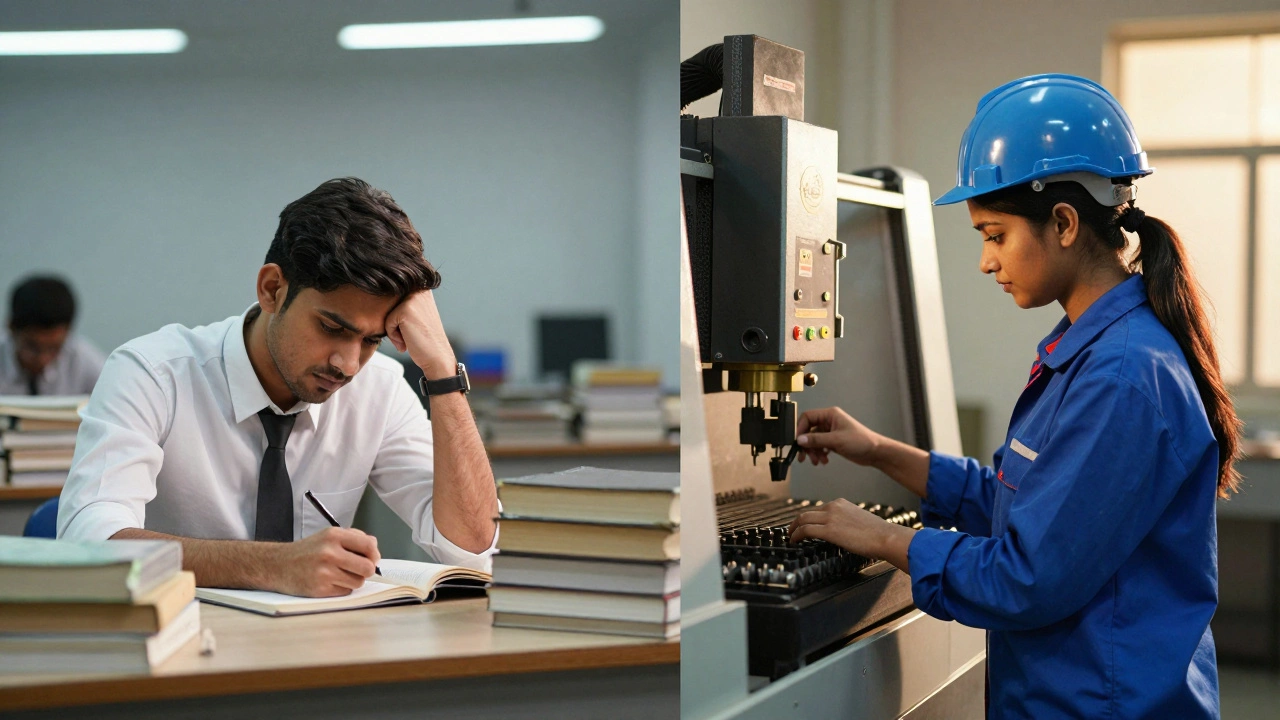
Here is the hard truth about higher education in India: millions of students spend four years and lakhs of rupees on a generic degree only to realize they have no practical skills when they hit the job market. Meanwhile, their peers who chose a polytechnic diploma are already working as junior engineers or technicians, earning a salary while their classmates are still writing final exams.
The question isn't just "is it worth it?" The real question is: does a diploma fit your specific career goals, financial situation, and learning style? For many Indians, the answer is a resounding yes. But for others aiming for top-tier corporate management roles, it might be a dead end without further study. Let’s break down the reality of pursuing a diploma in India today, looking at costs, salaries, and the actual day-to-day life of a diploma holder.
The Speed Advantage: Time Is Money
The biggest selling point of a three-year diploma programoffered by polytechnics across India is speed. In a country where unemployment among graduates is a persistent issue, entering the workforce three years earlier than your bachelor's degree peers is a massive advantage.
Consider this scenario: You finish Class 12 at age 18. If you choose a standard B.Tech (Bachelor of Technology) route, you graduate at 22. If you choose a diploma, you start working at 21. That one-year head start means:
- Early Earnings: You start contributing to your family income or saving for yourself immediately.
- Work Experience: By the time your B.Tech friend lands their first internship, you have two years of real-world experience under your belt.
- Financial Independence: You stop being a financial burden on your parents sooner.
In sectors like manufacturing, IT support, and healthcare, experience often outweighs the prestige of a university name. A diploma holder with two years of hands-on experience is frequently preferred over a fresh graduate with theoretical knowledge but zero practical exposure.
Cost Efficiency: Getting More for Less
Let’s talk numbers, because that’s what matters most to most Indian families. Private engineering colleges in India can charge anywhere from ₹3 lakh to ₹15 lakh per year. Over four years, that’s a debt trap for many middle-class families.
In contrast, government polytechnics charge nominal fees, often between ₹5,000 to ₹20,000 per year. Even private polytechnics rarely exceed ₹1-2 lakh per year. This makes diplomas incredibly accessible. You aren't just saving money; you are reducing risk. If you decide later that you want to switch careers, you haven't mortgaged your future to do so.
| Feature | Polytechnic Diploma (Govt) | Private Engineering College |
|---|---|---|
| Duration | 3 Years | 4 Years |
| Total Tuition Fee (Approx.) | ₹15,000 - ₹60,000 | ₹12,00,000 - ₹60,00,000+ |
| Entry Requirement | Class 10 / 12 Marks | JEE Main/State CET Scores |
| Focus | Practical Skills & Workshops | Theory & Academic Research |
Job Prospects: Where Do Diploma Holders Go?
A common myth is that diploma holders are stuck in low-level jobs forever. While entry-level positions are indeed technical, the ceiling is much higher than people think, especially in India’s booming infrastructure and manufacturing sectors.
Top recruiters for diploma graduates include:
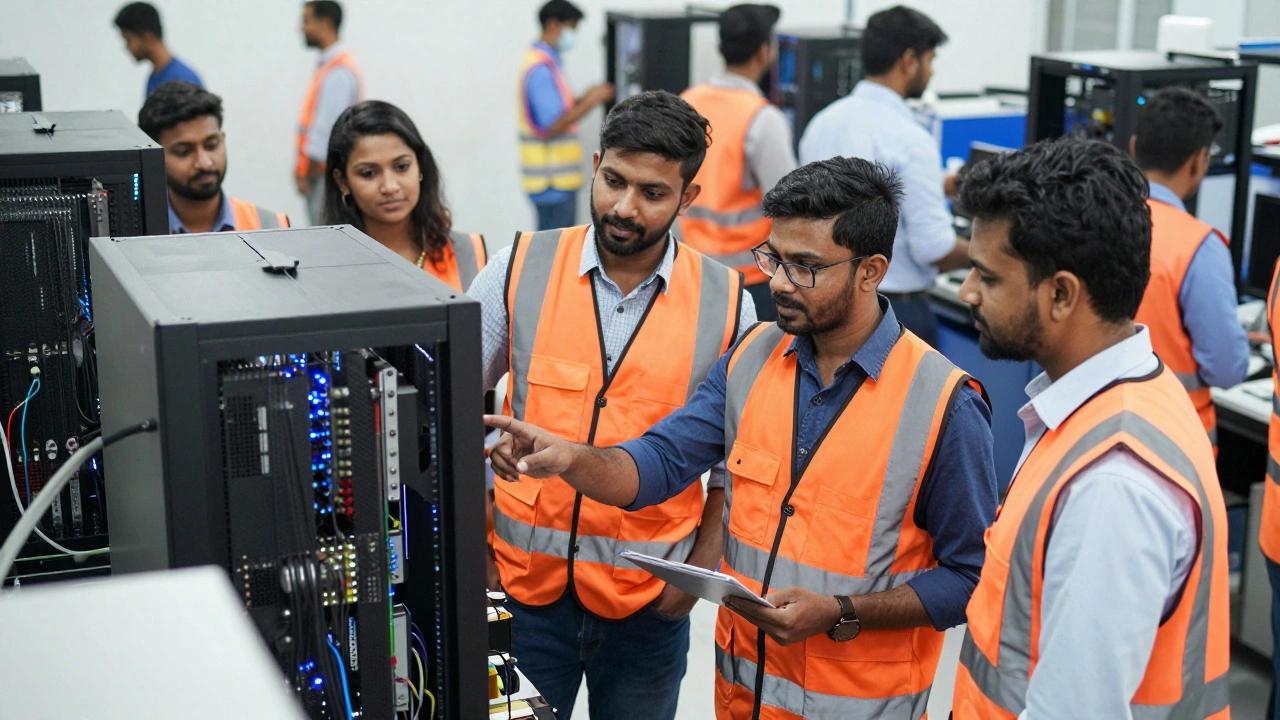
- Manufacturing Giants: Companies like Tata Motors, Mahindra, and Siemens hire diploma holders as Junior Engineers or Supervisors.
- IT Sector: Roles in hardware maintenance, network administration, and basic coding support are open to diploma grads.
- Healthcare: Nursing diplomas, lab technician courses, and radiology tech programs lead to stable, high-demand jobs in hospitals.
- Government Sector: SSC JE (Staff Selection Commission Junior Engineer) exams are exclusively for diploma holders, offering secure government jobs with good perks.
According to recent industry reports, the starting salary for a diploma engineer in India ranges from ₹2.5 lakh to ₹4.5 lakh per annum. In specialized fields like robotics or advanced electronics, this can go up to ₹6 lakh. Compare this to the average starting salary for a generic arts or commerce graduate, which is often lower and less stable.
The Bridge to Higher Education: Lateral Entry
One of the smartest features of the Indian education system is the lateral entry option. You don’t have to stay a diploma holder forever. After completing your diploma, you can enter directly into the second year of a B.Tech or B.E. program.
This is a game-changer. Why? Because you enter college with practical knowledge. While your batchmates struggle to understand how a circuit works in theory, you’ve already built one in the workshop. This gives you a unique edge in academics and projects. Many students use the diploma as a stepping stone to get into better engineering colleges through lateral entrance exams, which are often less competitive than direct JEE routes.
Skill-Based Learning vs. Theory
Indian universities are notorious for outdated syllabi. Professors teach from books written decades ago, while the industry moves forward rapidly. Polytechnics, however, are designed around vocational trainingfocused on practical application.
You spend more time in workshops, labs, and industrial visits than in lecture halls. You learn to operate CNC machines, wire electrical panels, code Python scripts, or manage hospital records. Employers love this because they don’t have to train you from scratch. You are "job-ready" from day one.
In a world where automation is taking over routine tasks, the ability to fix, maintain, and operate complex machinery is a superpower. Robots can write emails, but they can’t yet easily repair a broken turbine in a power plant. That’s where you come in.

When Is a Diploma NOT Worth It?
It’s important to be honest. A diploma isn’t the right path for everyone. Here are scenarios where you should reconsider:
- You Aim for Top-Tier Management: If your dream is to be an MBA graduate at a top IIM or work in investment banking, a diploma alone won’t cut it. You will need a bachelor’s and then a master’s degree.
- You Love Pure Research: If you want to become a scientist, professor, or researcher in academia, the theoretical depth of a four-year degree followed by a PhD is necessary.
- You Are Unwilling to Upskill: The tech world changes fast. A diploma gets you in the door, but continuous learning keeps you employed. If you plan to rest on your laurels, you will fall behind.
Choosing the Right Diploma Course
Not all diplomas are created equal. In India, the value of your diploma depends heavily on the institution and the field. Stick to institutions approved by the All India Council for Technical Education (AICTE). Avoid unrecognized private institutes that promise "jobs guaranteed"-these are often scams.
High-demand fields for 2026 and beyond include:
- Mechanical Engineering: Always needed in automotive and manufacturing.
- Computer Science & IT: Specifically in networking, cybersecurity, and hardware.
- Electrical/Electronics: Critical for renewable energy projects and EV (Electric Vehicle) infrastructure.
- Nursing & Allied Health: With an aging population, healthcare workers are in short supply.
- Hospitality & Hotel Management: Tourism is rebounding strongly post-pandemic.
Avoid saturated fields unless you have a specific niche skill. For example, a general "Business Administration" diploma has little value compared to a specialized "Digital Marketing" or "Supply Chain Logistics" course.
Final Verdict: Make It Work For You
So, is a diploma worth it in India? Absolutely, if you view it as a launchpad rather than a final destination. It offers a faster, cheaper, and more practical route to employment. It respects your time and your wallet.
But remember, the paper itself doesn’t get you hired. Your skills do. Use those three years to build a portfolio, intern, and network. Whether you stop there and climb the corporate ladder as a technical expert, or use lateral entry to get your engineering degree, you are ahead of the game. Don’t let societal pressure push you into a four-year degree if your heart and hands are ready to build, fix, and create now.
Can I get a government job with a diploma in India?
Yes, absolutely. Government bodies like SSC (Staff Selection Commission), RRB (Railway Recruitment Board), and various state public service commissions regularly recruit Junior Engineers and Technicians specifically for diploma holders. These jobs offer stability, pensions, and good benefits.
Is a lateral entry B.Tech better than a regular B.Tech?
The degree certificate is exactly the same. However, lateral entry students often have an advantage in practical subjects and projects because of their prior workshop experience. Academically, it is considered equivalent to a regular four-year degree.
What is the average salary after a diploma in India?
Starting salaries typically range from ₹2.5 lakh to ₹4.5 lakh per annum for engineering diplomas. Specialized fields like IT, robotics, or healthcare can command higher starting packages, sometimes exceeding ₹6 lakh depending on the company and location.
Do foreign companies recognize Indian diplomas?
Many multinational corporations operating in India recognize AICTE-approved diplomas for technical roles. For working abroad, some countries may require additional certification or equivalency checks, but skilled tradespeople are in high demand globally, especially in Europe and the Middle East.
Which is better: ITI or Diploma?
An ITI (Industrial Training Institute) course is shorter (1-2 years) and focuses on specific trade skills like electrician or fitter. A Diploma is longer (3 years) and provides broader engineering knowledge. If you want a quick start in a specific trade, choose ITI. If you want a wider career path with options for higher education, choose a Diploma.