
Vocational vs. Commerce Career Path Finder
Answer these questions to find out if a Skilled Trade (Vocational) or Commercial Trade path aligns better with your goals.
Recommended Path
Key Benefits:
Typical Roles:
Education Route:
When people talk about "trade" in India, they often get two very different things mixed up. One side is the world of buying and selling-imports, exports, and marketplaces. The other side is the hands-on work-the electricians, plumbers, carpenters, and technicians who build and maintain the country’s infrastructure. If you are looking into trade courses india, you are likely interested in that second path: the skilled vocational routes that offer stable careers without necessarily requiring a four-year university degree.
The Indian economy runs on both wheels. You have the massive service and commerce sector, but you also have a growing demand for skilled labor. Understanding the difference between these types of trade is crucial if you want to pick a career path that actually fits your goals. Let’s break down what these trades look like, how they are regulated, and where they lead.
The Skilled Trades: Vocational and Technical Work
This is the core of what most people mean when they ask about trade schools or vocational training. These are jobs that require specific technical skills, usually learned through apprenticeships, polytechnic diplomas, or certification courses. In India, this sector is governed largely by the Ministry of Skill Development and Entrepreneurship (MSDE) and bodies like the National Council for Vocational Education and Training (NCVET).
These trades are not just "backup plans." They are specialized professions. Think of an HVAC technician who keeps data centers cool, or a CNC machinist who creates precision parts for automotive factories. These roles pay well because they require expertise that cannot be faked.
| Trade Category | Common Roles | Typical Qualification |
|---|---|---|
| Electrical & Electronics | Electrician, Wireman, Technician | ITI Certificate / Polytechnic Diploma |
| Mechanical & Automotive | Fitter, Turner, Mechanic, Welder | ITI Certificate / Apprenticeship |
| Construction & Civil | Carpenter, Mason, Plumber, Painter | ITI Certificate / On-the-job Training |
| Healthcare Support | Lab Assistant, Radiographer, Nurse Aide | Diploma / Certificate Course |
| Information Technology | Hardware Engineer, Network Technician | Polytechnic / Certification (e.g., CCNA) |
The entry point for many of these trades is the Industrial Training Institute (ITI). ITIs are government-run institutions that offer short-term courses ranging from six months to two years. Upon completion, students receive a National Trade Certificate (NTC), which is recognized across India. This certificate allows you to register as a skilled worker with the Directorate General of Employment and Training (DGET).
Another key player here is the Apprentices Act of 1961. This law mandates that certain industries must take on apprentices. For someone starting out, an apprenticeship combines classroom learning with paid on-the-job experience. It’s one of the best ways to enter a trade because you earn while you learn, and you graduate with real-world references.
The Commerce Sector: Import, Export, and Domestic Trade
On the flip side, we have commercial trade. This involves the exchange of goods and services for money. In India, this sector is huge, contributing significantly to the GDP. It includes everything from local kirana stores to multinational export houses.
Commercial trade is generally divided into three buckets:
- Domestic Trade: Buying and selling within India. This includes wholesale markets (like Mandis for agriculture) and retail chains. It relies heavily on logistics, supply chain management, and understanding local consumer behavior.
- International Trade (Import/Export): Trading goods across borders. India is a major exporter of textiles, pharmaceuticals, IT services, and gems/jewelry. This type of trade requires knowledge of customs regulations, Incoterms, and international banking instruments like Letters of Credit.
- Service Trade:
- Selling intangible products like software, consulting, tourism, and financial services. With the rise of digital platforms, service trade has exploded. An Indian developer working for a US client is part of this trade ecosystem.
If you are interested in this side of trade, the educational path looks different. Instead of ITI, you might look at Bachelor of Commerce (B.Com) degrees, CA (Chartered Accountancy) courses, or specialized certifications in International Business and Logistics. The goal here is not manual skill but strategic, legal, and financial acumen.
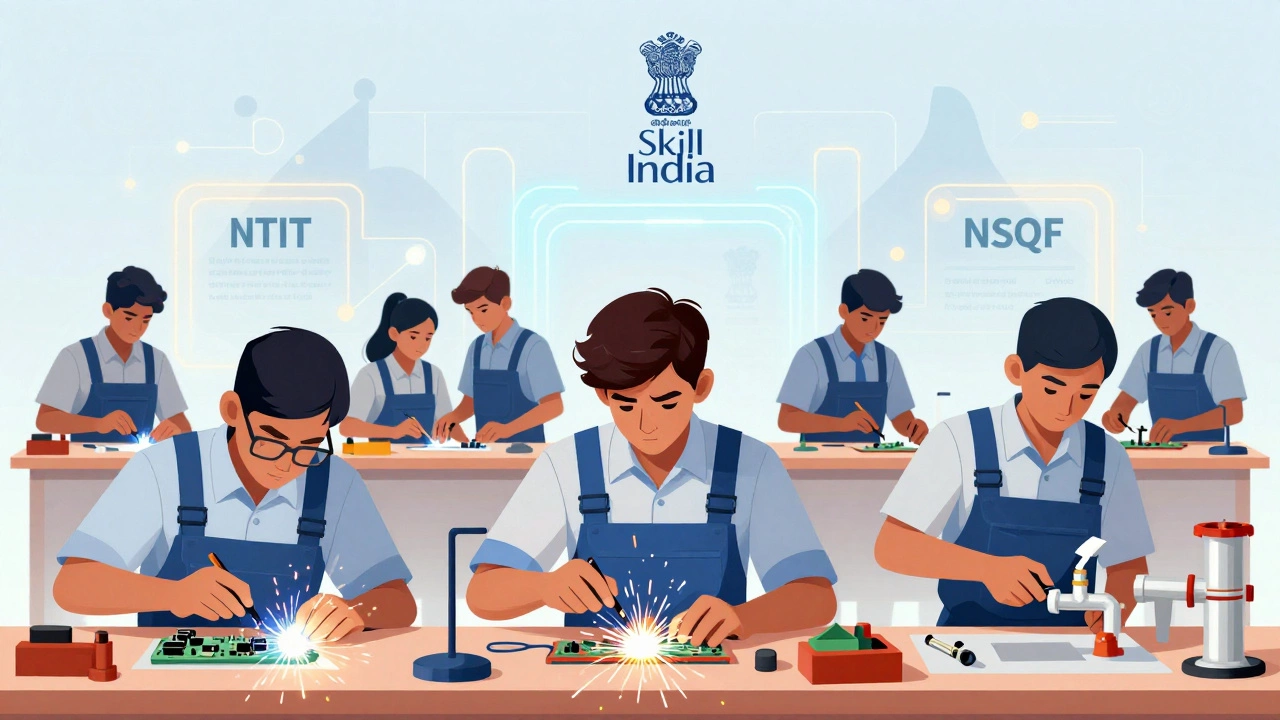
Government Initiatives Shaping the Trade Landscape
You can’t talk about trade in India today without mentioning the government’s push to formalize and upgrade the sector. Two initiatives stand out:
Skill India Mission is a flagship campaign launched by the Government of India to train over 400 million Indians in various skills by 2022, with continued expansion into 2025-2026. Its goal is to make India the global hub for quality education and skill development. Under this umbrella, sectors like renewable energy, healthcare, and smart manufacturing are getting new course curricula.
Then there is the National Skills Qualifications Framework (NSQF) is a framework that organizes qualifications based on levels of knowledge, skills, and aptitude required for employment. Before NSQF, a certificate from one state might not be respected in another. Now, trades are graded on a level system (Level 1 to Level 8). This makes it easier for employers to understand exactly what a candidate can do. For example, a Level 3 qualification indicates basic competency, while Level 5 suggests advanced supervisory skills.
These frameworks matter because they add credibility. When you hold an NSQF-aligned certificate, you are speaking a common language with employers across the country.

Choosing Your Path: What Should You Consider?
So, which type of trade is right for you? It depends on your personality, resources, and long-term vision.
If you enjoy working with your hands, solving physical problems, and seeing immediate results from your work, the vocational route is likely better. Trades like electrical wiring or plumbing have low barriers to entry but high ceilings for mastery. You can start small and eventually run your own contracting business. The job security is high because buildings always need maintenance.
If you prefer numbers, negotiation, and strategy, the commercial trade route might suit you. However, be aware that this space is more competitive. A B.Com degree alone doesn’t guarantee a job. You need additional skills in digital marketing, supply chain analytics, or foreign languages to stand out.
Here is a quick checklist to help you decide:
- Time Investment: Vocational trades often take 6-24 months to become job-ready. Commerce careers may require 3-4 years of higher education plus internships.
- Cost: ITI and polytechnic fees are generally lower than private university degrees. Scholarships are widely available for vocational students.
- Earning Potential: Entry-level wages in skilled trades can be modest, but experienced technicians often earn more than mid-level office managers. In commerce, earnings scale with performance and sales targets.
- Physical Demand: Trades can be physically demanding. Commerce roles are sedentary but can involve high mental stress and irregular hours.
The Future of Trade in India
The landscape is changing fast. Automation is impacting some traditional manufacturing jobs, but it is creating new ones. There is a massive shortage of technicians who can repair and maintain automated machinery. Similarly, the e-commerce boom has created a huge demand for last-mile delivery drivers, warehouse managers, and packaging specialists-all of which are trade-related roles.
Green energy is another frontier. As India shifts towards solar and wind power, there is a critical need for solar panel installers, wind turbine technicians, and battery storage experts. These are emerging trades that didn’t exist a decade ago. Training in these areas now positions you for a future-proof career.
Whether you choose to wire a house or negotiate a cross-border deal, the key is specialization. Generalists struggle; specialists thrive. Pick a niche, get certified, and keep upgrading your skills. That is the real secret to success in any type of trade in India.
What is the difference between ITI and Polytechnic?
ITI (Industrial Training Institute) offers shorter courses, typically 1 to 2 years, leading to a National Trade Certificate. It focuses on specific skilled trades like electrician or fitter. Polytechnic colleges offer 3-year diploma programs in engineering branches like mechanical or civil. Polytechnic graduates are considered junior engineers and have broader theoretical knowledge compared to ITI holders.
Are trade certificates valid all over India?
Yes, certificates issued under the National Skill Qualifications Framework (NSQF) and by recognized bodies like NCVET are valid across India. This standardization ensures that a skill credential earned in one state is accepted by employers in another.
Which trade has the highest demand in India currently?
High-demand trades include electrical and electronics technicians due to infrastructure growth, healthcare assistants due to expanding medical facilities, and renewable energy technicians (solar/wind) due to government green energy initiatives. IT hardware support is also consistently in demand.
Can I start a business with a trade certificate?
Absolutely. Many successful entrepreneurs start with vocational training. For example, an electrician can start their own contracting firm, or a tailor can launch a clothing brand. Trade skills provide the foundational expertise needed to deliver quality services or products independently.
What is the role of an apprentice in Indian trades?
An apprentice is a trainee who works under the supervision of a skilled worker or engineer. Governed by the Apprentices Act, 1961, apprentices receive stipends and gain practical experience. Completing an apprenticeship often leads to permanent employment or enhanced employability in the industry.