
2-Year Computer Diploma Salary Calculator
Calculate Your Potential Salary
See how much you could earn with different 2-year computer diplomas in India
Estimated Annual Salary
₹0
Two years can change your earning potential-if you pick the right path. In India, a 2-year degree isn’t just a backup plan anymore. It’s a fast track into well-paying tech jobs without the time or cost of a full four-year engineering degree. Many students assume you need a B.Tech to land a good salary in IT, but that’s not true. Some of the highest-paying jobs today go to people with diplomas and advanced certificates in computer-related fields. The question isn’t whether a 2-year degree is worth it. The real question is: which 2-year computer degree pays the most?
Diploma in Computer Science and Engineering
This is the most common and highest-paying 2-year option for students after 12th grade. Offered by polytechnics across India-like NIOS, state technical boards, and private institutes like Aptech and NIIT-it covers core programming, databases, networking, and basic system design. Graduates often land roles as junior software developers, system support engineers, or network technicians.
What makes this diploma stand out? It’s the direct link to entry-level tech jobs. Companies like TCS, Infosys, Wipro, and HCL hire diploma holders through campus placements. Starting salaries range from ₹2.4 lakh to ₹4.5 lakh per year in Tier-1 cities. In Tier-2 cities like Pune, Hyderabad, or Ahmedabad, you can still expect ₹1.8 lakh to ₹3.2 lakh. The real growth comes after 2-3 years of experience. Many diploma holders move into full-stack development or DevOps roles, crossing ₹8 lakh annually.
Key advantage: You can start working while others are still in their second year of college. Many students begin internships in their first year. By graduation, they already have 12-18 months of real project experience.
Diploma in Information Technology (IT)
Similar to Computer Science, but more focused on practical IT infrastructure. This program teaches you how to manage servers, troubleshoot networks, deploy cloud services, and handle cybersecurity basics. It’s ideal for students who like fixing systems more than writing code.
Graduates often become IT support specialists, network administrators, or cloud operations assistants. Companies like Dell, Accenture, and Tech Mahindra hire heavily from these programs. Starting salaries: ₹2.2 lakh to ₹4 lakh per year. In metro cities, roles in cloud support (AWS, Azure) pay even higher-up to ₹4.8 lakh for those with certifications like CompTIA A+ or AWS Certified Cloud Practitioner.
One big benefit: You can add certifications on top of your diploma for free or low cost. Many institutes partner with Microsoft Learn or Google Career Certificates. A diploma + AWS certification can push your salary 30% higher than a diploma alone.
Diploma in Cybersecurity
This is the fastest-growing 2-year computer course in India. With over 400,000 cybersecurity jobs unfilled nationwide, companies are desperate for trained talent. Programs in cybersecurity teach threat analysis, ethical hacking, firewall configuration, incident response, and data protection laws like India’s DPDP Act.
Graduates get hired as security analysts, junior penetration testers, or SOC (Security Operations Center) analysts. Startups and mid-sized IT firms pay ₹3 lakh to ₹5 lakh for freshers. Large banks (like HDFC, ICICI) and government agencies (like NIC, C-DAC) offer even higher packages-up to ₹6 lakh for certified candidates.
Why it pays more: Cybersecurity roles require specialized skills. Unlike general programming, you can’t learn this on YouTube alone. Formal training gives you the structure and credibility employers trust. Adding CEH (Certified Ethical Hacker) or CompTIA Security+ after your diploma can boost your salary to ₹7-8 lakh within a year.
Diploma in Data Analytics
Data is the new oil-and India is running out of people who know how to pump it. A 2-year diploma in Data Analytics teaches you SQL, Excel, Power BI, Tableau, and basic Python for data cleaning and visualization. No advanced math or statistics degree required.
Graduates work as data analysts, business intelligence associates, or reporting specialists. Industries hiring: e-commerce (Flipkart, Amazon India), fintech (Paytm, Razorpay), healthcare, and logistics. Starting salary: ₹2.8 lakh to ₹4.5 lakh. In Bangalore and Gurgaon, companies pay ₹5 lakh+ for candidates who can build dashboards and interpret sales trends.
Real example: A student from a government polytechnic in Jaipur completed a data analytics diploma, learned Power BI in 3 months, and got placed at a logistics startup. Within 18 months, he was managing analytics for 50+ delivery routes. His salary jumped from ₹3 lakh to ₹6.2 lakh.
Diploma in Artificial Intelligence and Machine Learning
Don’t be fooled by the hype. You don’t need a B.Tech in AI to start working in the field. Many institutes now offer 2-year diplomas focused on applied AI: chatbots, image recognition, predictive modeling using Python and scikit-learn. These programs avoid heavy math and focus on tools businesses actually use.
Graduates become AI model assistants, automation testers, or junior ML engineers. Companies like Zomato, Swiggy, and Udaan hire these candidates to build recommendation engines and chatbots. Starting salary: ₹3.2 lakh to ₹5.5 lakh. With 1-2 years of experience, you can move into roles managing AI tools for customer service or inventory forecasting-earning ₹8-10 lakh.
Pro tip: Build a portfolio. Even 3 small projects-like a spam email classifier or a sales forecast model-can get you hired over a B.Tech graduate with no real work.
How to Choose the Right Program
Not all diplomas are created equal. Here’s how to pick the one that pays best:
- Check placement records-Ask for last year’s placement stats. Look for companies that hired, not just the number of students placed.
- Look for industry partnerships-Programs tied to Microsoft, AWS, Google, or TCS have better job pipelines.
- Ask about certifications-Does the course include free access to CompTIA, Google, or AWS certifications?
- Visit the lab-If the institute doesn’t have updated computers or software, skip it.
- Read student reviews-Check YouTube or Reddit for honest experiences, not just the college website.
Avoid programs that promise "guaranteed jobs" or charge over ₹1.5 lakh in fees. Most top-paying diplomas cost under ₹50,000 per year at government polytechnics.
What You Can Earn After 5 Years
Here’s what graduates from these programs actually make after gaining experience:
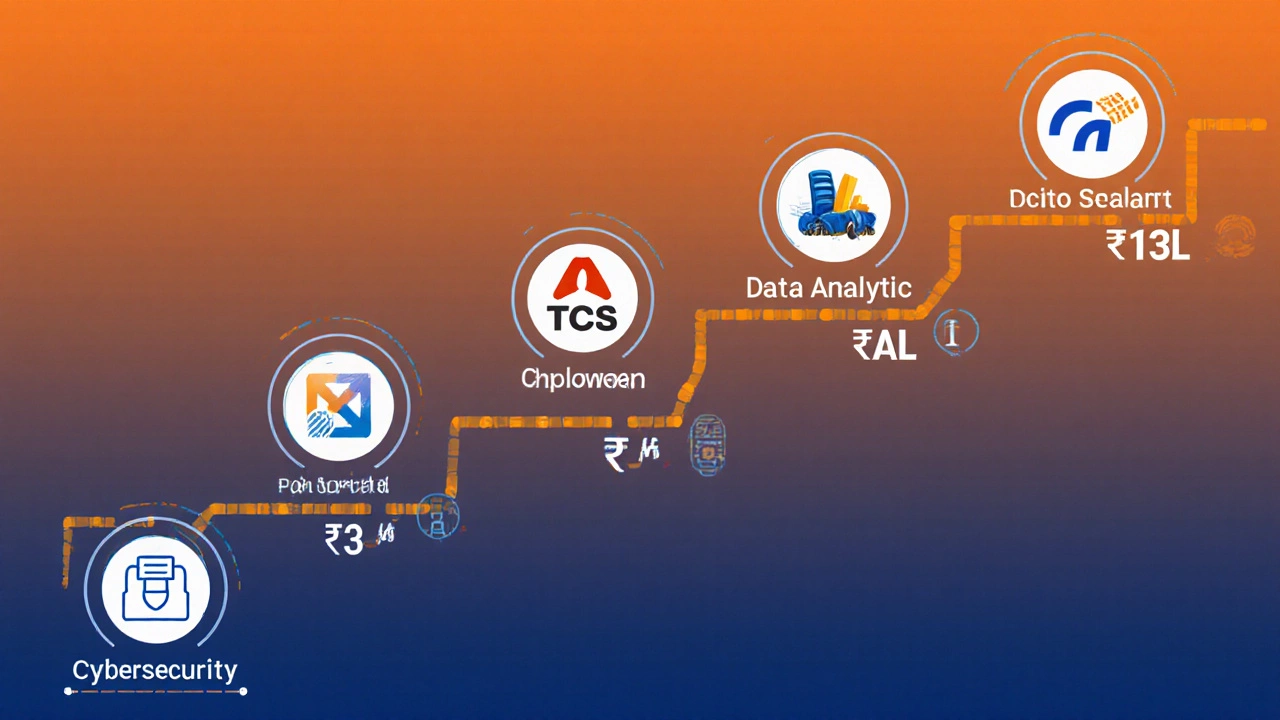
| Diploma Type | Starting Salary (₹/year) | Salary After 5 Years (₹/year) |
|---|---|---|
| Computer Science & Engineering | 2.4-4.5L | 6-9L |
| Information Technology | 2.2-4L | 5.5-8.5L |
| Cybersecurity | 3-6L | 8-12L |
| Data Analytics | 2.8-4.5L | 7-10L |
| AI & Machine Learning | 3.2-5.5L | 8-13L |
Notice a pattern? Cybersecurity and AI lead the pack. But even the most common diploma-Computer Science-can get you to ₹9 lakh if you keep learning.

Common Myths About 2-Year Degrees
- Myth: "No company hires diploma holders." Truth: TCS, Infosys, and Wipro hire 30-40% of their entry-level staff from polytechnics.
- Myth: "You can’t get promoted without a degree." Truth: Many companies promote based on skills, not degrees. A diploma holder with strong coding skills often gets promoted faster than a B.Tech grad who just passed exams.
- Myth: "It’s only for students who failed 12th." Truth: Top students choose diplomas because they want to start working earlier and earn while learning.
Next Steps: How to Get Started
Here’s your 3-step plan:
- Find a government polytechnic near you. Fees are under ₹20,000/year. Use the NCVT portal to locate approved institutes.
- Apply for the 2-year Computer Science or Cybersecurity diploma-these have the highest ROI.
- Start learning free certifications while studying. Complete Google Data Analytics or AWS Cloud Practitioner during your second year.
You don’t need to wait for college admissions. Applications for 2026 are open now. Most polytechnics start in July. If you act fast, you can begin your career by next year.
Which 2-year computer course has the highest salary in India?
The Diploma in Cybersecurity and the Diploma in Artificial Intelligence & Machine Learning currently offer the highest starting salaries, ranging from ₹3 lakh to ₹6 lakh per year. After 5 years of experience, professionals in these fields often earn between ₹8 lakh and ₹13 lakh annually, especially in metro cities and tech hubs like Bangalore, Hyderabad, and Pune.
Can I get a good job with just a 2-year diploma in computer science?
Yes. Many IT companies in India hire diploma holders for entry-level roles like software developer, network technician, and data analyst. Companies like TCS, Infosys, and Wipro have dedicated recruitment drives for polytechnic graduates. With hands-on projects and certifications, your diploma can be just as valuable as a 4-year degree.
Are government polytechnics better than private institutes for computer diplomas?
Generally, yes. Government polytechnics offer lower fees (under ₹20,000/year), recognized certifications through NCVT, and better placement records. Private institutes often charge more and may not have industry partnerships. Always check if the institute is approved by the National Council for Vocational Training (NCVT).
Do I need to do a B.Tech after my 2-year diploma?
No, not for a good salary. Many diploma holders earn more than B.Tech graduates early in their careers. However, if you want to move into management, research, or higher education later, you can join B.Tech through lateral entry after your diploma. But for most tech roles, skills and experience matter more than the degree label.
What certifications should I get along with my diploma?
For Cybersecurity: CompTIA Security+, CEH. For Data Analytics: Google Data Analytics Certificate, Microsoft Power BI. For AI/ML: Google AI Fundamentals, AWS Certified Machine Learning - Specialty. For IT: CompTIA A+, AWS Cloud Practitioner. These certifications cost under ₹10,000 and can boost your salary by 20-40%.
Final Thought
There’s no single "best" 2-year degree. But if you want to earn the most, focus on Cybersecurity, AI, or Data Analytics. These fields are growing fast, and India doesn’t have enough trained people. The diploma is your ticket in. The rest-skills, projects, certifications-is up to you. Start now. The next hiring cycle won’t wait.