Indian Education Equivalence Checker
Follow the steps below to check how your Indian qualifications compare to global standards.
You’re looking at job applications or university admissions abroad, and you see a requirement for a "High School Diploma" or "GED." You pause. You grew up in India. You have your Class 10 board results and maybe your Class 12 certificate. But nowhere on those papers does it say "Diploma." This confusion creates a massive roadblock for students aiming to work or study in the United States, Canada, Australia, or New Zealand.
The short answer is that India does not issue a document literally called a "High School Diploma." Instead, the Indian education system uses board examinations to certify completion of secondary education. However, these certificates are widely accepted as equivalents to a high school diploma by international institutions. Understanding this equivalence-and when you might actually need a GED-is crucial for navigating global opportunities.
How the Indian Education System Maps to Global Standards
To understand what counts as a diploma, we first need to look at how schooling works here compared to the West. In the United States, students attend high school from grades 9 through 12. Upon completing grade 12, they receive a High School Diploma, which is a certificate awarded upon successful completion of secondary education requirements.
In India, the structure is slightly different but functionally similar. Secondary education is divided into two main stages:
- Secondary School (Class 10): Often referred to as Matriculation. This completes ten years of schooling.
- Higher Secondary (Class 11 and 12): Also known as Intermediate or Pre-University. This completes twelve years of schooling.
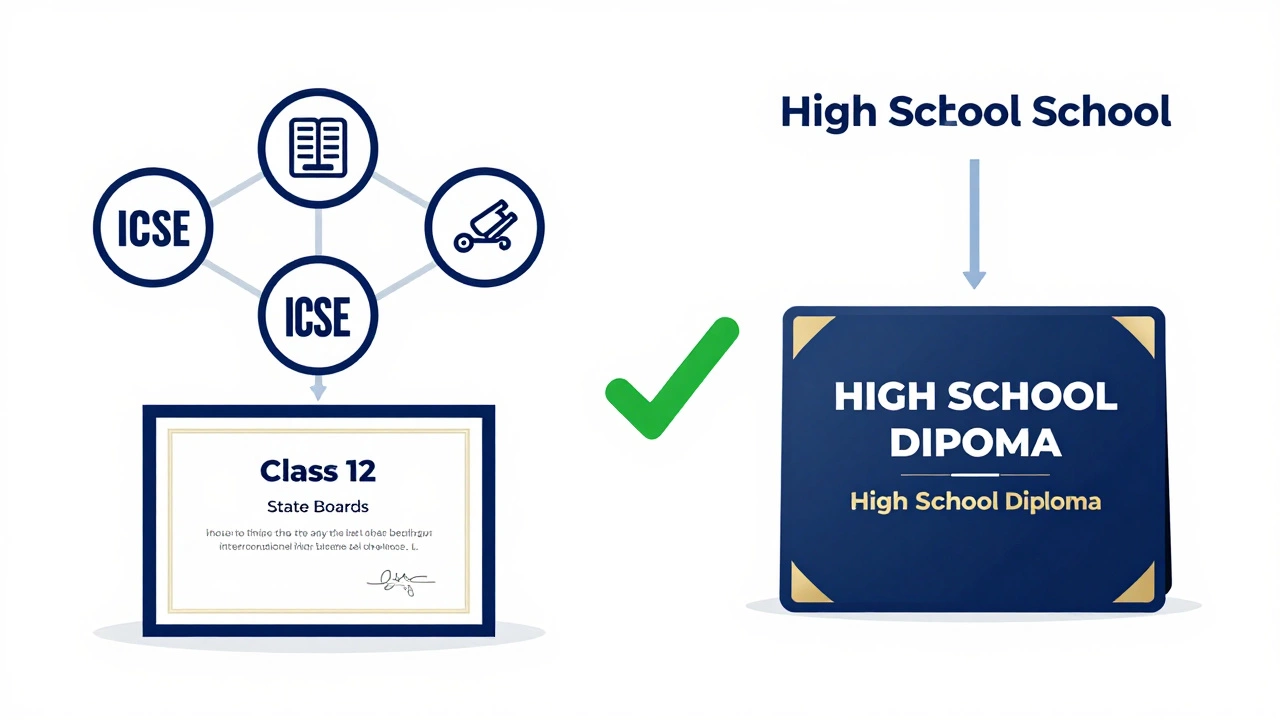
When an international employer or university asks for a "High School Diploma," they are asking for proof that you have completed twelve years of formal education. In the Indian context, your Class 12 Certificate issued by recognized state boards like CBSE, ICSE, or State Boards serves this exact purpose. It proves you have finished the standard secondary curriculum.
The key difference lies in the assessment method. American diplomas often rely on continuous grading, attendance, and extracurriculars throughout four years. Indian certificates are primarily based on final board examinations conducted at the end of Class 10 and Class 12. Despite this structural difference, the academic rigor is comparable, which is why the Class 12 certificate holds its weight globally.
Is the GED Available in India?
This is where things get tricky. The GED stands for General Educational Development, a test series that serves as a US high school equivalency credential. It is designed for people who did not complete traditional high school but want to prove they have the knowledge of a typical 18-year-old high school graduate.
Here is the critical reality: **You generally cannot take the GED test in India.** The GED is administered exclusively within the United States and its territories, plus a few specific partner countries. There are no official GED testing centers in Mumbai, Delhi, Bangalore, or any other Indian city.
If you are currently residing in India, pursuing a GED is logistically nearly impossible unless you travel to the US specifically to take the exam, which defeats the purpose for most applicants. For Indian students, the GED is rarely the right path. It is typically used by non-traditional learners in the US who dropped out of school. If you are following the standard Indian curriculum, your local board exams are the superior and recognized alternative.
Which Indian Boards Are Recognized Abroad?
Not all certificates carry the same weight internationally. To ensure your Class 12 results are accepted as equivalent to a high school diploma, you must be enrolled in a recognized board. The three major pillars of Indian secondary education are:
| Board Name | Full Form | Recognition Level | Best For |
|---|---|---|---|
| CBSE | Central Board of Secondary Education | National & International | Students planning to study in the US, UK, or Canada |
| ICSE | Indian Certificate of Secondary Education | National & International | Students focusing on language proficiency and detailed curriculum |
| State Boards | Various (e.g., Maharashtra, UP, Tamil Nadu) | National | Local university admissions; may require additional verification for foreign universities |
CBSE is the most widely recognized board for international mobility. Its curriculum aligns closely with global standards, making it easier for foreign admissions officers to evaluate your marks. ICSE is known for its rigorous English medium instruction and comprehensive syllabus, which is also highly respected. State boards are valid equivalents, but some universities in competitive countries like the UK or Australia may request a transcript evaluation to verify the difficulty level of your specific state’s curriculum.
Class 10 vs. Class 12: Which One Counts?
A common point of confusion is whether the Class 10 certificate (Matriculation) is enough. In many countries, including the US, high school ends after grade 12. Therefore, your Class 10 certificate alone is not considered equivalent to a high school diploma. It is viewed as incomplete secondary education.
To satisfy the "High School Diploma" requirement, you must provide your Class 12 mark sheet and passing certificate. Some institutions may ask for both Class 10 and Class 12 documents to create a full picture of your academic history, but the Class 12 result is the deciding factor. It confirms you have completed the full 12-year cycle.
If you only have a Class 10 certificate and did not pursue Class 11 and 12, you do not hold a high school diploma equivalent. In this scenario, you would need to consider alternative pathways, such as vocational training programs or adult education courses offered by open universities in India, rather than attempting to get a GED.
How to Prove Equivalence for Jobs and Universities
Having the paper isn't always enough. When applying for jobs or higher education abroad, you often need to formally prove that your Indian certificate equals their local standard. Here is how you handle that process.
1. WES Evaluation
For studies or immigration to Canada and the US, many organizations require a credential evaluation from WES, which is World Education Services, a leading credential evaluation agency. You send your original Class 12 transcripts and certificates to WES. They review them and issue a report stating that your Indian qualification is equivalent to a US High School Diploma. This report becomes your golden ticket for applications.
2. Direct University Admission
Many universities in the UK, Australia, and Europe accept Indian Class 12 certificates directly without needing a third-party evaluation. They have internal teams familiar with CBSE and ICSE grading systems. Always check the specific entry requirements page of the university you are targeting.
3. Employer Verification
For job applications, employers usually just need a scanned copy of your Class 12 certificate. If they are unfamiliar with the Indian system, providing a simple cover letter explaining that "Class 12 from CBSE is equivalent to Grade 12 completion" often clears up confusion immediately.
Alternatives if You Don’t Have Class 12
If you missed out on formal schooling or dropped out before Class 12, you are not stuck. While the GED is unavailable, India has robust alternatives for adult learners and dropouts.
National Institute of Open Schooling (NIOS)
NIOS offers distance learning programs for secondary and senior secondary education. You can enroll in NIOS to complete your Class 10 or Class 12 exams at your own pace. The NIOS certificate is legally equivalent to CBSE or State Board certificates. It is fully recognized by universities and employers in India and abroad. This is the closest functional equivalent to the GED pathway available within India.
Diploma Courses
If your goal is employment rather than university admission, consider a technical diploma. A three-year engineering or polytechnic diploma after Class 10 is often valued more highly than a generic high school diploma in industries like construction, IT support, and manufacturing. These vocational qualifications demonstrate practical skills that employers actively seek.
Common Mistakes to Avoid
Navigating international education requirements can lead to costly errors. Avoid these common pitfalls:
- Assuming Class 10 is enough: Never submit only your Matriculation certificate for a high school diploma requirement. It will likely be rejected.
- Trying to fake a GED: Do not attempt to buy a fake GED certificate online. Background checks and credential evaluations will expose this instantly, leading to permanent bans from universities or visa rejections.
- Ignoring Translation Requirements: If your state board certificate is in a regional language, you must get it translated into English by a certified translator. Foreign institutions cannot read documents in Hindi, Tamil, or Bengali without official translations.
- Missing Notarization: Some countries require your copies to be notarized. Check if the receiving institution needs "certified true copies" rather than just scans.
Understanding the landscape helps you present your credentials confidently. Your Indian education is valid and powerful. You just need to frame it correctly for the international audience.
Can I use my Class 10 certificate as a high school diploma?
No. A Class 10 certificate represents 10 years of schooling, whereas a high school diploma requires 12 years. International institutions view Class 10 as incomplete secondary education. You must provide your Class 12 certificate to meet the high school diploma requirement.
Where can I take the GED test in India?
You cannot take the GED test in India. The GED is only administered in the United States and its territories. For Indian residents seeking an equivalent credential, the National Institute of Open Schooling (NIOS) is the recommended alternative.
Is CBSE Class 12 accepted in the USA?
Yes, CBSE Class 12 is widely accepted in the USA as equivalent to a high school diploma. Most universities and employers recognize it directly. For certain immigration purposes or specific university applications, you may need a WES evaluation to formally confirm the equivalence.
What is the difference between a Diploma and a Degree in India?
In India, a "Diploma" usually refers to a vocational or technical course lasting 1-3 years, often taken after Class 10 or Class 12. A "Degree" (like B.Tech or BA) is a university program lasting 3-4 years after Class 12. Neither is called a "High School Diploma," but the Class 12 certificate serves the function of the high school diploma.
Do I need to translate my Indian board certificates?
If your certificates are in English (like CBSE or ICSE), no translation is needed. If they are in a regional language (from many State Boards), you must provide a certified English translation along with the original documents for international applications.