
Job Stress Predictor
Job Stress Assessment
Assess how stressful a tech job might be based on your role, company type, and work conditions.
Stress Assessment Result
If you’ve taken a computer course in India - whether it’s a diploma in IT, a certification in Python, or a full-degree in computer science - you’ve probably heard the same question: "What job will you get?" But nobody tells you how stressful that job might be. The truth? Not all tech jobs are glamorous. Some leave you drained, anxious, and questioning your choices. And in India, where competition is fierce and expectations are sky-high, certain roles stand out as especially tough.
Software Developers in Startups
Startups in Bengaluru, Hyderabad, or Pune promise innovation, equity, and a dynamic culture. But behind the free snacks and open-office vibes lies a different reality. Many junior developers work 12-hour days, seven days a week, especially during product launches. They’re expected to handle everything: frontend, backend, database, DevOps, and even customer support. One 24-year-old developer from Chennai told me he didn’t take a single day off for nine months. His company had only five engineers. When someone got sick, everyone else picked up their work. No overtime pay. No real backup. Just pressure to ship code, fast.
Why is this common? Because startups in India often operate with 30% of the budget of their U.S. or European counterparts but with 200% of the workload. The expectation isn’t just to code - it’s to solve problems no one else has figured out yet. And if the startup fails? You’re back to square one, with no savings and burnout.
IT Support Engineers in BPOs
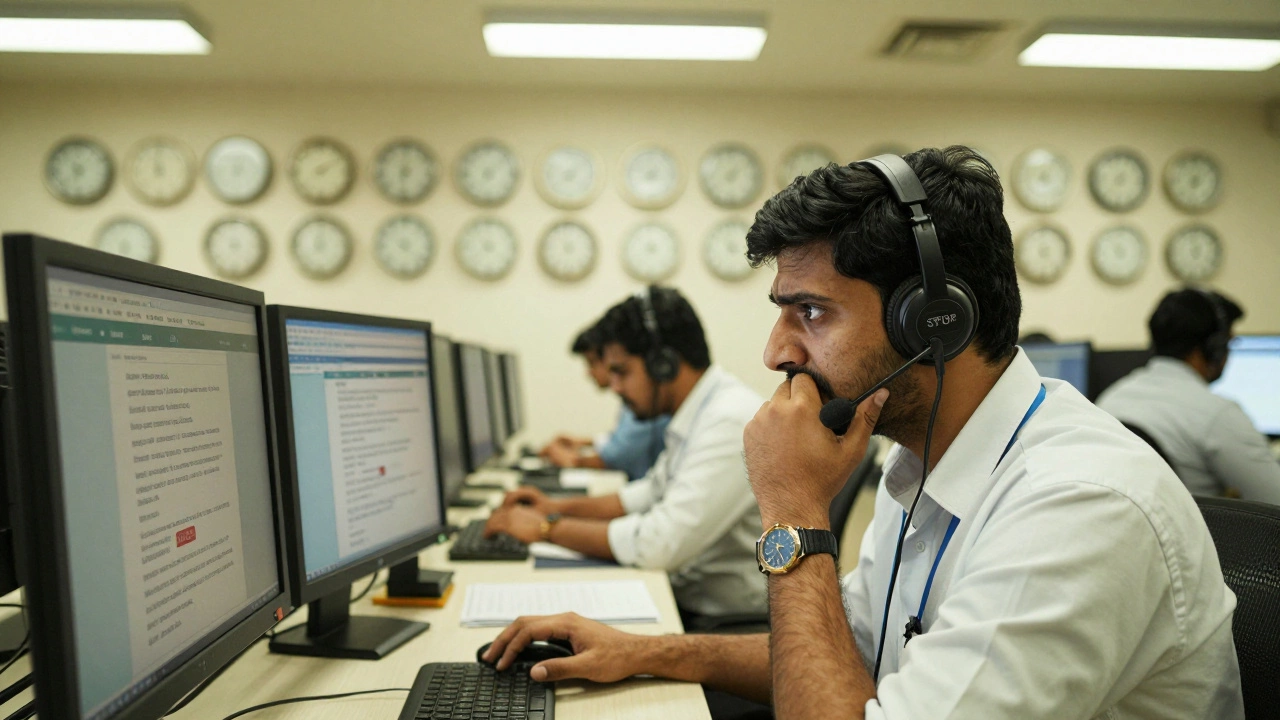
If you took a computer course and ended up in an IT support role at a BPO - like those in Noida, Gurgaon, or Mumbai - you might think you got a safe job. You’re wrong. These roles are among the most stressful in the tech sector. You’re on call 24/7, handling calls from clients in the U.S., UK, or Australia. Your schedule flips every week. One week you work midnight to 8 a.m. The next, 8 a.m. to 4 p.m. Then it’s 4 p.m. to midnight. No consistency. No sleep rhythm.
You’re not fixing servers. You’re calming angry customers who don’t understand why their Netflix isn’t loading. You’re told to follow scripts. No room for creativity. No room for error. Miss one step, and you get flagged. Miss three, and you’re on a performance review. One 2025 survey by the Indian Society for Human Resource Development found that 68% of IT support staff in BPOs reported chronic insomnia, and 41% had been diagnosed with anxiety disorders. The turnover rate? Over 50% in the first year.
DevOps Engineers Under Pressure
DevOps sounds cool. Automate deployments. Monitor servers. Scale systems. But in India, DevOps roles are often understaffed and overburdened. A single DevOps engineer might be responsible for 50+ applications across cloud platforms like AWS, Azure, and Google Cloud. One outage means thousands of users lose access. And it’s always your fault - even if the issue came from a third-party API or a change made by another team.
Many companies don’t hire enough DevOps staff. They assume one person can handle what should be a team of three. The result? Constant pager alerts. Sleep interrupted. Family time sacrificed. A 2024 report from the National Association of Software and Services Companies (NASSCOM) showed that DevOps engineers in India work an average of 62 hours per week - the highest among all tech roles. And 73% said they felt "always on," even during weekends.
Quality Assurance Testers in High-Stakes Environments
QA testers are the unsung heroes of software development. But in India, they’re treated like disposable labor. You’re hired for ₹18,000 a month to test apps that users expect to be flawless. One missed bug - even one tiny typo - can lead to a public backlash. And you’re expected to test everything manually because automation tools are "too expensive."
In fintech or healthcare software companies, a single error can mean financial loss or even health risks. That pressure is real. Testers often work late nights before a product launch, running through hundreds of test cases, checking every button, every form field, every edge case. No recognition. No promotion path. Many QA roles don’t even have clear career progression. You’re stuck testing forever - unless you learn to code. And even then, you’re still treated as second-tier.
Freelance Coders Without Safety Nets
Freelancing sounds flexible. You pick your projects. Set your hours. Work from home. But in India, freelance coders face a hidden cost: instability. There’s no salary. No health insurance. No paid leave. One client cancels a project, and you’re out of income for weeks. You’re competing with thousands of others on platforms like Upwork and Fiverr, often forced to undercut your own rates just to get work.
A 2025 study by the Indian Freelancers Association found that 62% of freelance developers in India earn less than ₹25,000 per month, despite working 50+ hours. Many take on multiple gigs at once - one client for a website, another for mobile app fixes, a third for debugging legacy code. They’re juggling deadlines, payment delays, and communication gaps across time zones. Mental fatigue is common. And there’s no HR department to talk to when things get overwhelming.

Why Do These Jobs Feel So Heavy?
It’s not just the hours. It’s the culture. In India, tech jobs are often seen as "prestigious," so people don’t talk about the stress. If you complain, you’re told: "You chose this. It’s a good job. Others would kill for it." But that doesn’t make the pressure go away.
Companies rarely invest in mental health. Employee wellness programs are rare. Counseling is stigmatized. Managers are often promoted from technical roles themselves - they never learned how to lead people, only how to code. So burnout becomes normal. Exhaustion becomes a badge.
And the system doesn’t help. There are more computer course graduates than jobs. In 2025, over 1.8 million students graduated with IT-related degrees. But only 40% landed roles directly related to their field. The rest end up in roles they didn’t train for - and they’re expected to perform at elite levels anyway.
What Can You Do?
If you’re already in one of these roles, here’s what actually helps:
- Set hard boundaries. Say no to after-hours work unless it’s a true emergency.
- Learn to automate. Even basic scripting can cut your workload in half.
- Find a peer group. Join online communities of Indian tech workers. Talk about stress. You’re not alone.
- Track your hours. If you’re working more than 50 hours a week for months, it’s time to reassess.
- Ask for promotion or a raise - not just for your skills, but for your mental load.
If you’re still choosing a path after a computer course? Avoid roles that don’t have clear boundaries. Look for companies that mention "work-life balance" in their job descriptions - and then check Glassdoor reviews from real employees. Don’t believe the hype.
It’s Not About the Job Title - It’s About the Culture
A software engineer at a well-funded startup in Bangalore might have less stress than one at a small firm in Jaipur. A QA tester at a global bank might have better support than one at a local fintech app. The job title doesn’t define the stress. The company culture does.
Some Indian tech firms are starting to change. They offer mental health days. They hire dedicated HR for tech teams. They let employees disconnect after hours. But they’re still the exception. Most aren’t there yet.
If you’re choosing a career after a computer course - don’t just pick the highest salary. Pick the one with the most humanity.
Are all tech jobs in India stressful?
No, not all tech jobs are equally stressful. Roles like data analysts at established firms, UI/UX designers in well-funded startups, or technical writers at product companies often have more predictable hours and lower pressure. Stress depends more on company size, leadership, and workload expectations than the job title itself.
Which computer course leads to the least stressful job?
Courses that lead to roles like technical writing, UI/UX design, or data analysis tend to have lower stress levels. These jobs usually involve less on-call pressure, fewer emergency fixes, and more structured workflows. A diploma in UI/UX design or a certification in data visualization can open doors to calmer, more sustainable careers.
Why do Indian tech companies expect such long hours?
Many Indian tech firms operate with tight budgets and high client demands. They assume employees will work extra hours because labor is cheaper than hiring more staff. There’s also a cultural belief that long hours equal dedication. But this mindset is slowly changing, especially among younger workers and global-facing companies.
Can you avoid stress by working remotely?
Not necessarily. Remote work can make stress worse if you’re expected to be available 24/7 or if you’re isolated from peer support. The key isn’t location - it’s boundaries. Whether you’re in an office or at home, you need clear rules about when you’re off-duty.
What’s the best way to escape a stressful tech job in India?
Start by building skills that give you options - like learning automation, improving communication, or gaining project management experience. Then look for roles in companies that value sustainability over speed. Many Indian startups now offer flexible hours and mental health benefits. Switching to one of those can make a huge difference.
The tech industry in India is growing - but it’s growing unevenly. Some people thrive. Others break. The difference? Not talent. Not effort. It’s whether the system around them supports their well-being. Choose wisely. Your mind matters more than your code.